
 TRAVEL



 RECIPES WITH A STORY









 AUSTRIA-VIENNA




 SLOVAKIA-BRATISLAVA


 EVENTS




 INTERVIEWS

When you visit the Hofburg in Vienna, the former main residence of the Habsburgs, and turn into the passageway in the courtyard with the statue of Emperor Francis II/I, you will come to the so-called Swiss Courtyard (Schweizerhof). Here, you will find yourself not only in the heart of the Hofburg but also in the center of Habsburg power. This is the place with the entrance to the Imperial Treasury, which houses all the symbols of the power and grandeur of the Habsburg imperial family – crowns, jewellery, ceremonial robes and garments, as well as other precious objects.
I have visited the Treasury several times, and I am still fascinated by the many unique objects demonstrating the amazing goldsmith’s work. Here is a list of my top 9 exhibits:
1. The Crown of Emperor Rudolf II.
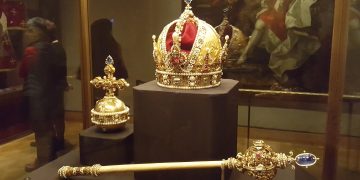
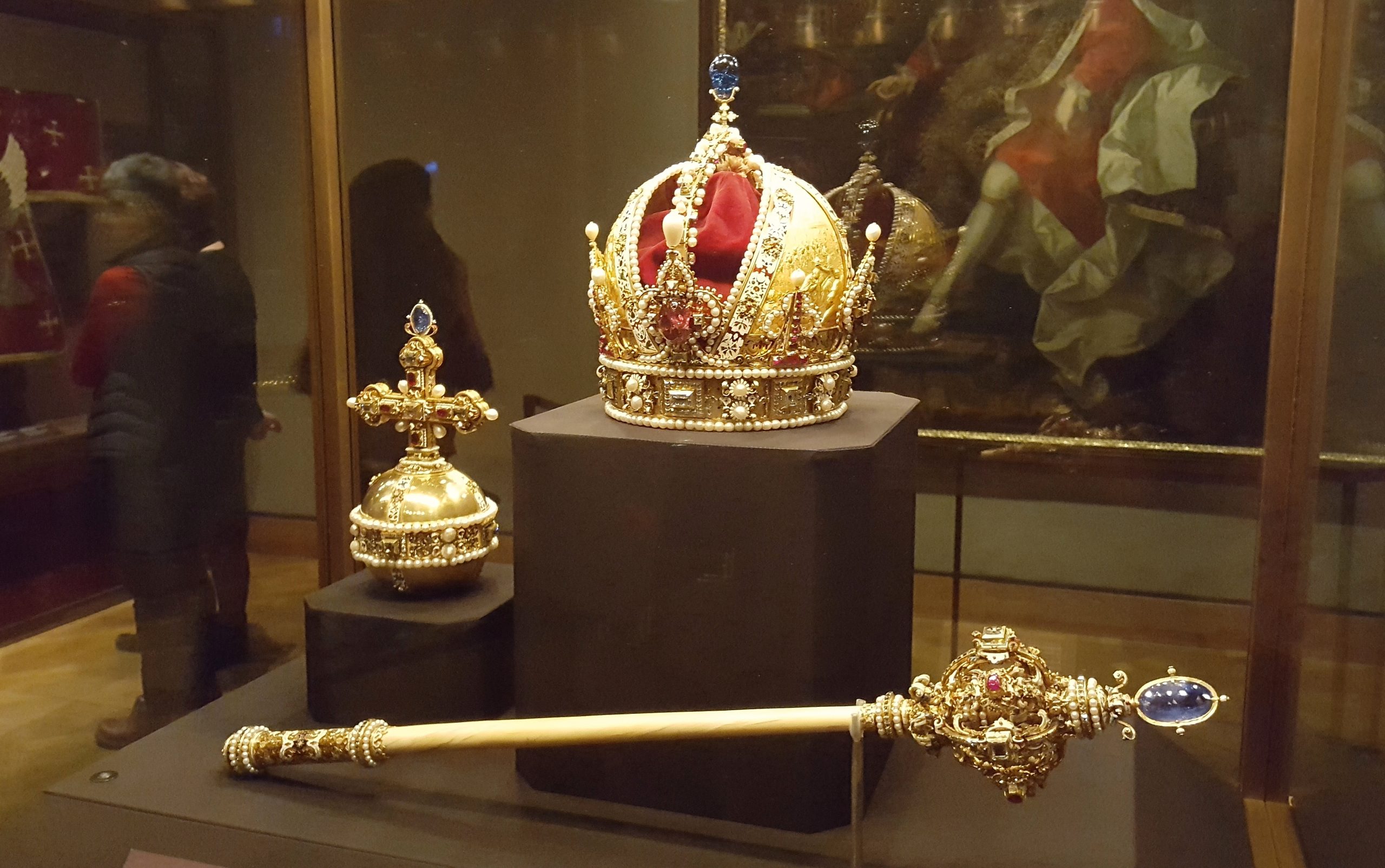
Every proper treasury must have a crown – the one in Vienna even has more than one, but for me, this one is the best. Many even consider it the most beautiful crown in the world! That’s why it deserves the longest description.
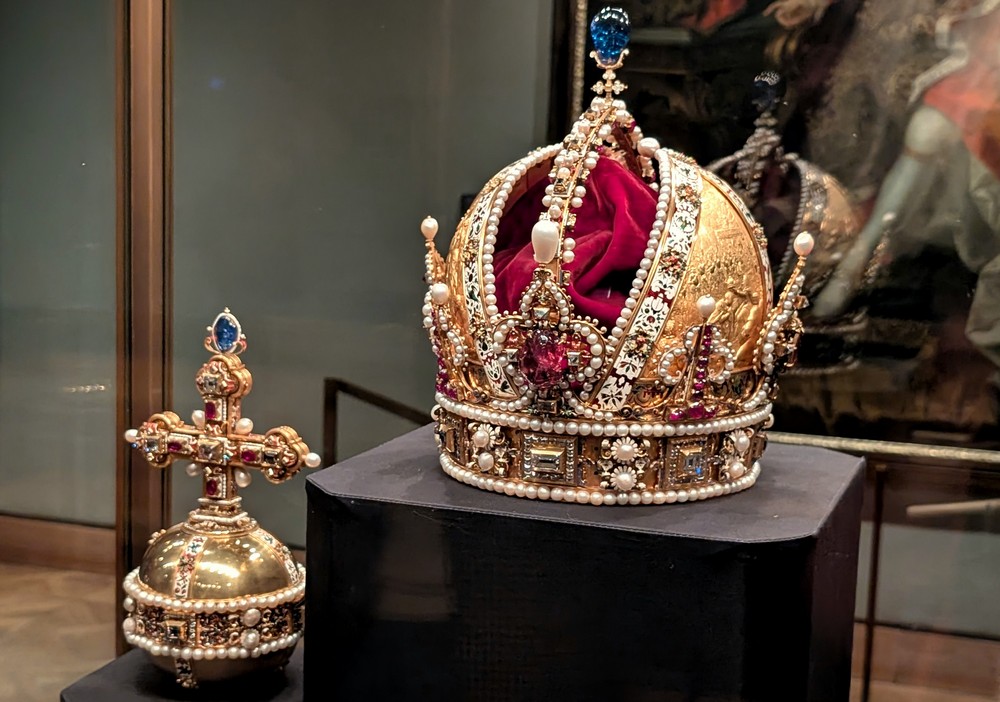
Since the crown of the Holy Roman Empire (which we will discuss in a moment) had been kept in Nuremberg since 1424 and was used only for coronations, rulers also needed a private crown for public appearances. The only such crown that has been preserved is that of Rudolf II. In 1804, Emperor Francis II/I declared this jewel to be the Austrian Imperial Crown, but no Austrian emperor was ever crowned with it.
Pearls (the most valuable are two larger pear-shaped ones on the front and back lilies), 194 South American diamonds, large rubies, a small Greek cross with a magnificent stone on it – a blue sapphire from Kashmir – as the key to heaven or the foundation stone of the future heavenly Jerusalem. For the emperor does not have his power from himself, but it is given to him from above, by the grace of God.
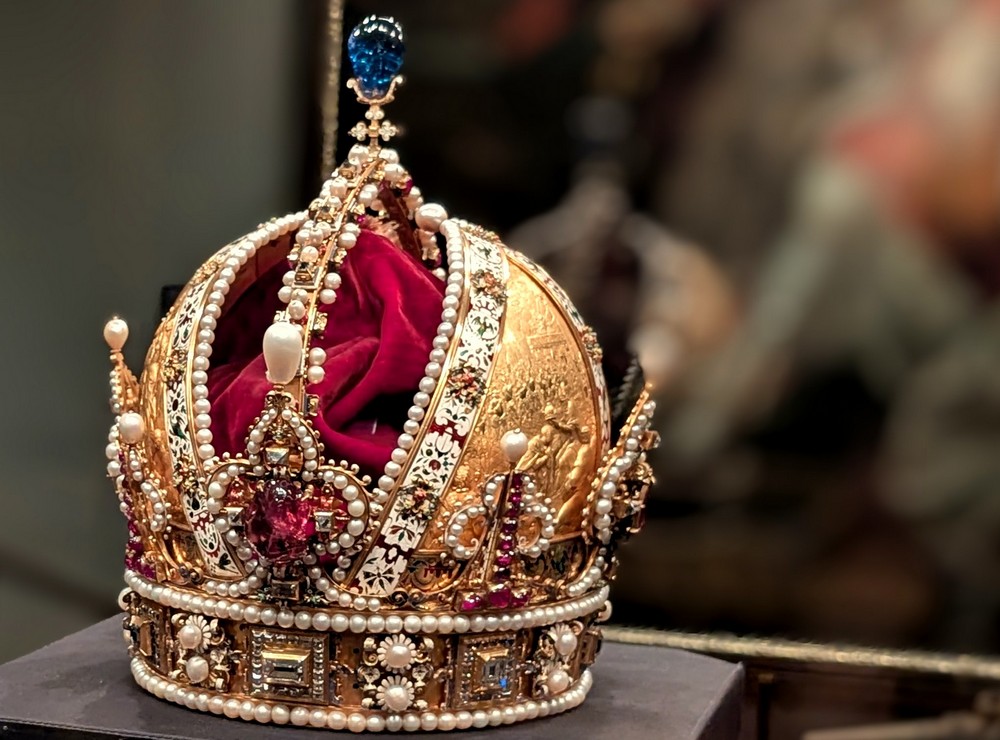
The most interesting are the four triangular shields of matte and shiny gold, where Rudolf had himself immortalised in all four of his main ranks:
1. as a general – it means, as the victor over the Ottomans. In front of the emperor in full armor and with a scepter in his hand, lie the enemy’s weapons and two bound Turkish soldiers (in the lower corners), although Rudolf actually achieved only minor diplomatic successes.
2. as Emperor of the Holy Roman Empire – crowned in Regensburg Cathedral (the coronation took place on November 1, 1575)
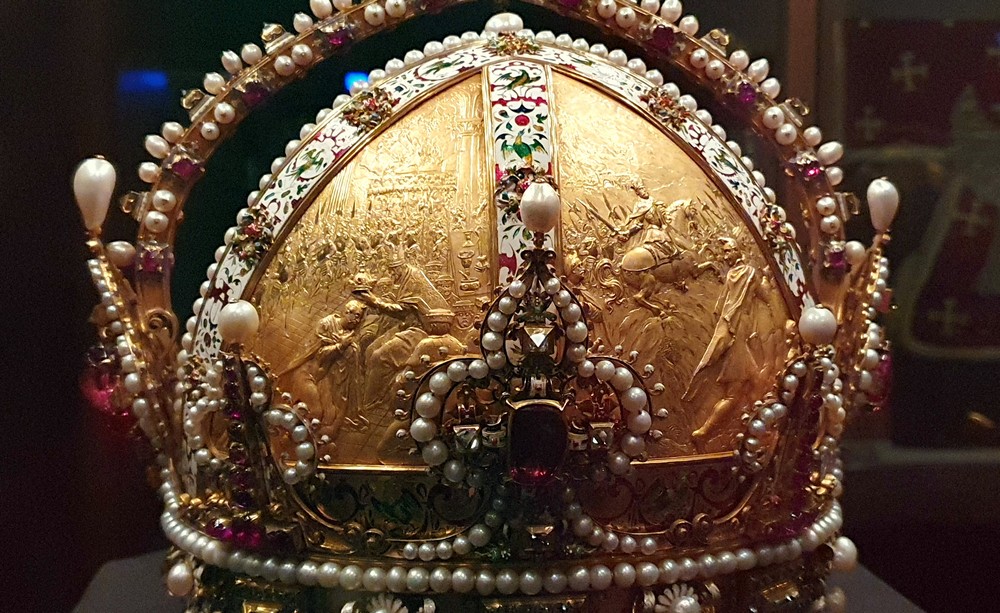
3. as King of Hungary – immediately after his coronation (September 26, 1572) in St. Martin’s Cathedral in Pressburg (today Bratislava) on Coronation Hill, pointing his sword in all directions (a symbol that he will defend his empire against all enemies). The lily covers the Hungarian coat of arms.
4. as King of Bohemia – during the coronation procession to Hradčany in Prague (January 22, 1575). The lower lily on the right covers the shield with the Bohemian lion.
This unique jewel was made in 1602 by the Flemish jeweller Jan Vermeyen, whom Rudolf II summoned to his court workshop in Prague.
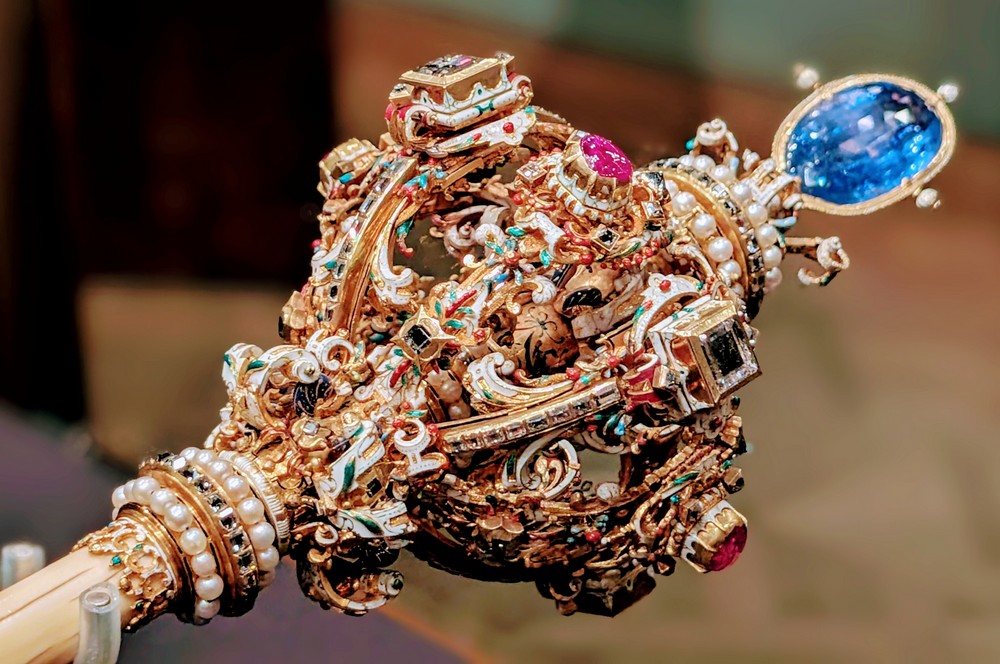
The set also includes scepter and orb, which were commissioned by Matthias II when he ascended the throne in 1612 after his older brother Rudolf, in the workshop of his Prague court goldsmith Andreas Osenbruck. In the past, it was believed that the scepter was partly made from the horn of a mythical unicorn as a symbol of God, but in reality, it is the tooth of a narwhal. Both objects, but especially the scepter, are further examples of perfect goldsmithing.
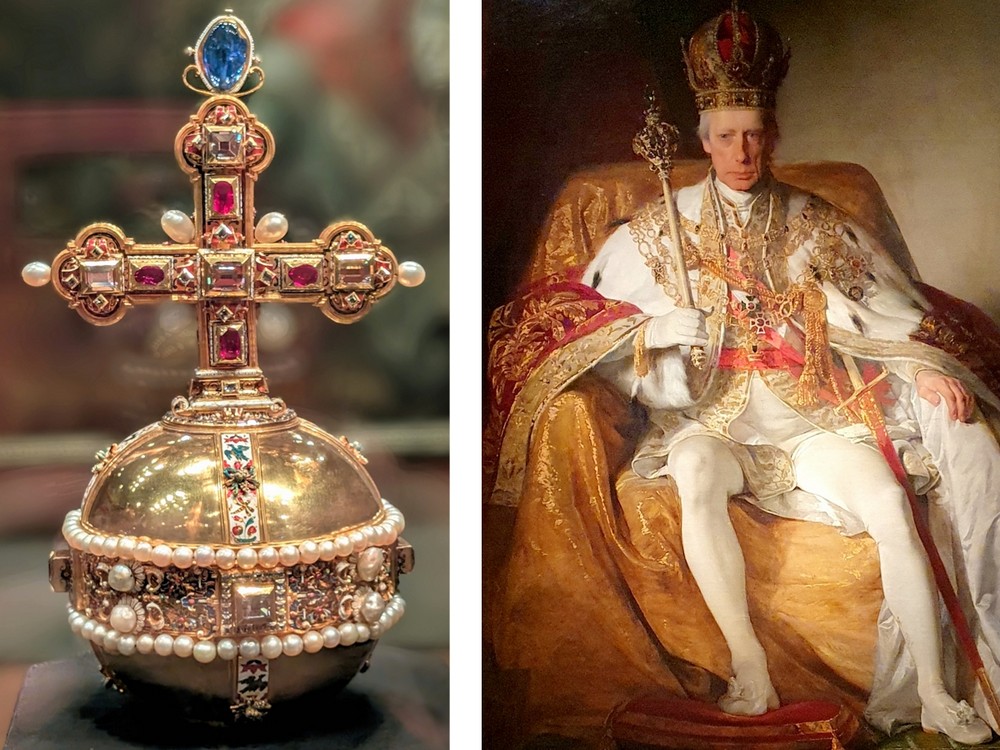
In the room, you will also find a bust of Rudolf II, but without the crown. If you want to see what the crown looked like on a head, look at the painting of Emperor Francis II/I.
2. Insignia of the Holy Roman Empire
One of the large paintings shows Joseph II at his coronation as Roman Emperor at the Frankfurt am Main Cathedral in 1764. Three archbishops place the imperial crown on his head. The original of this crown is also on display in the treasury, and it is another amazing piece of goldsmith’s work with many symbols.
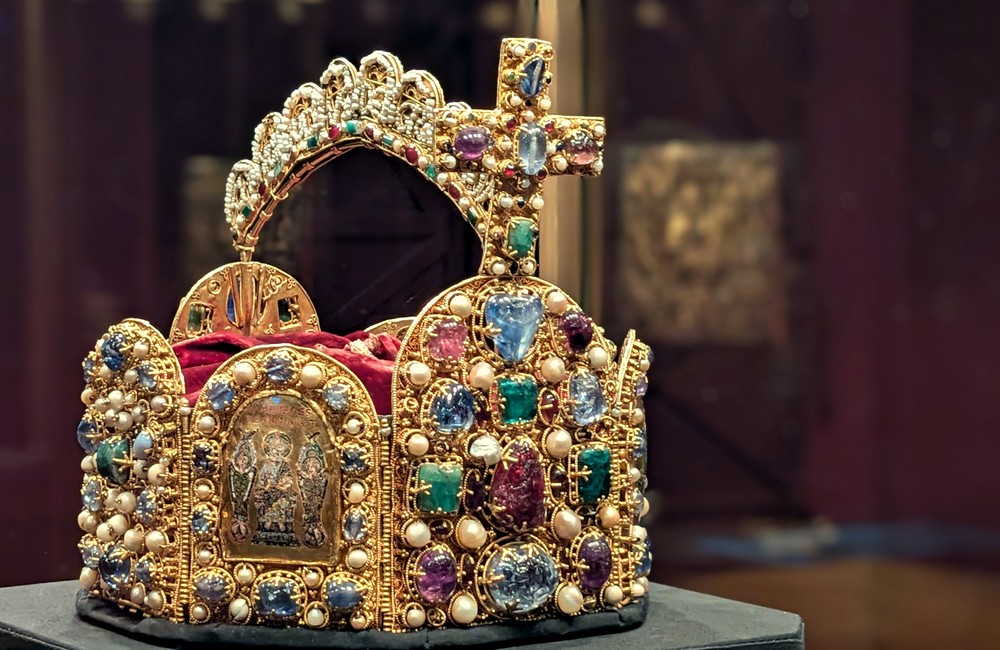
The crown, made in the second half of the 10th century, probably for the coronation of Emperor Otto the Great in 962, is made of gold (gold is not only a precious and durable metal, but also a symbol of spiritual, supernatural light) and enamel, decorated with precious stones and pearls.
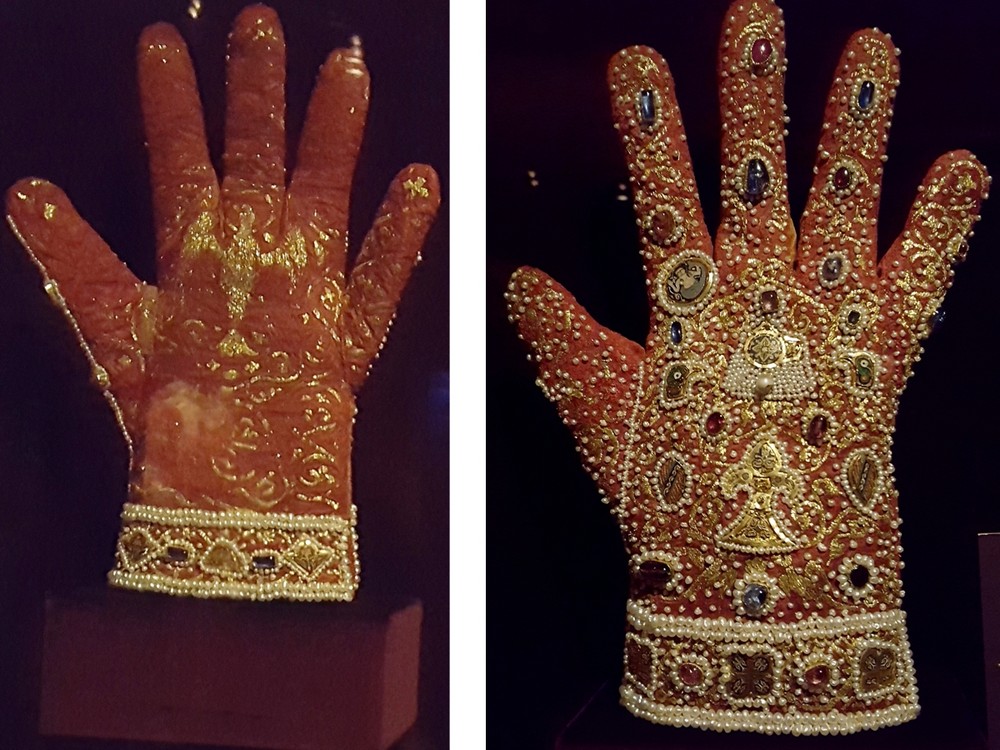
The insignia also include other items: a cloak, tunics, shoes, stockings, a stole, a cross, a sword, an orb, coronation gospels and even gloves that one could easily mistake for an extravagant fashion accessory worn by Michael Jackson. They are made of red velvet and decorated not only with gold embroidery, but also with gold appliqués, enamel plates with various motifs, pearls, rubies, sapphires, amethysts, garnets, spinels and corundums.
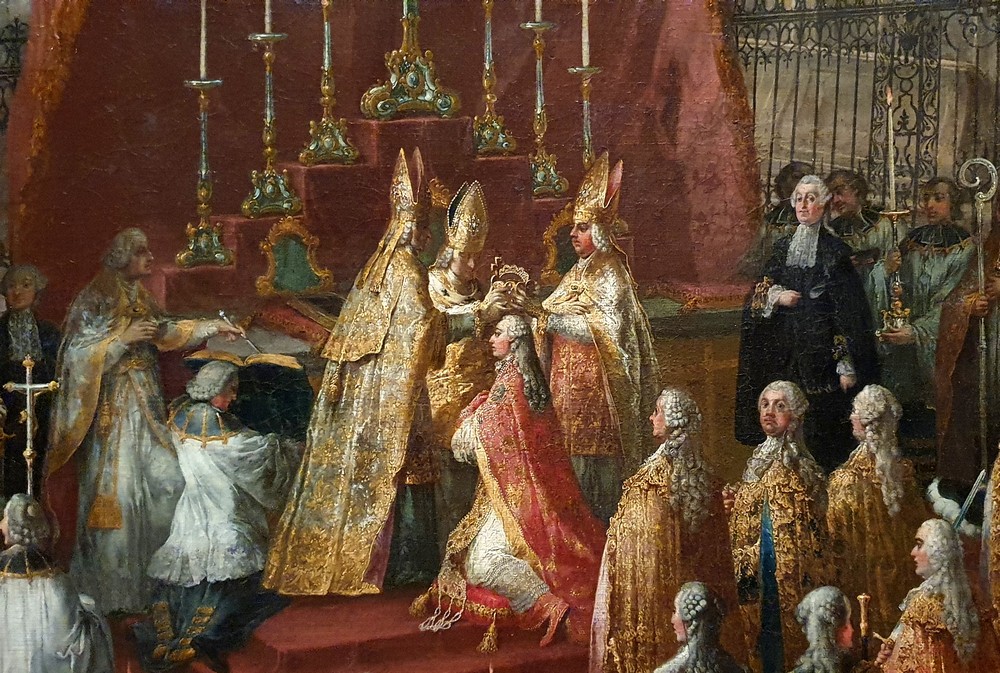
The act of coronation has always been extremely important. It was not a written decree that had made a monarch king, but the coronation. Therefore, it had been just as important to keep the coronation regalia safe, which is why they had to change location at least eight times during the thousand-year history of the Holy Roman Empire. They arrived in Vienna in 1800 for protection from Napoleon’s French troops. However, their journey was not over yet. Hitler also took an interest in these precious items and had them transported to Nuremberg, where they remained until 1945. They then returned to Vienna and have never been allowed to leave Austria since. You can see how these coronation robes and objects suited the monarch in the painting of Charlemagne (a copy based on Albrecht Dürer).
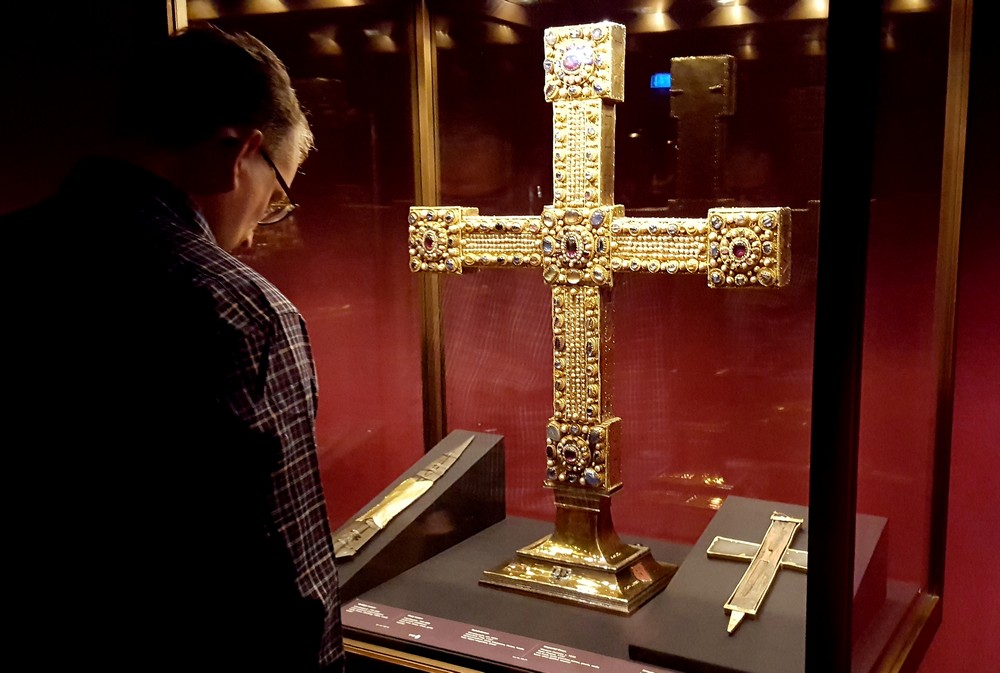
The coronation aimed to create a Western empire closely linked to the Pope. The emperor served as the earthly representative of Christ, the true ruler of the world. Wherever the emperor appeared, the imperial cross was carried before him.
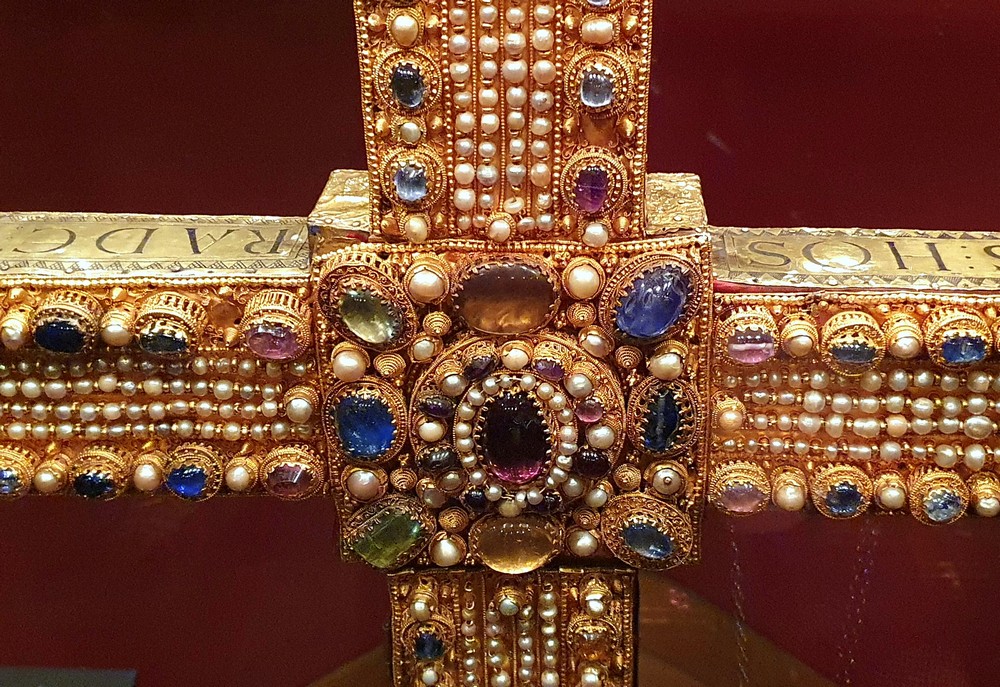
It is a magnificent work of art. The oak wood core is covered with red fabric and lined with gold leaf on the outside. The front is richly decorated with pearls and precious stones.
The back is just as interesting. In the center is the Agnus Dei (Lamb of God), surrounded by the 12 apostles and symbols of the four evangelists.
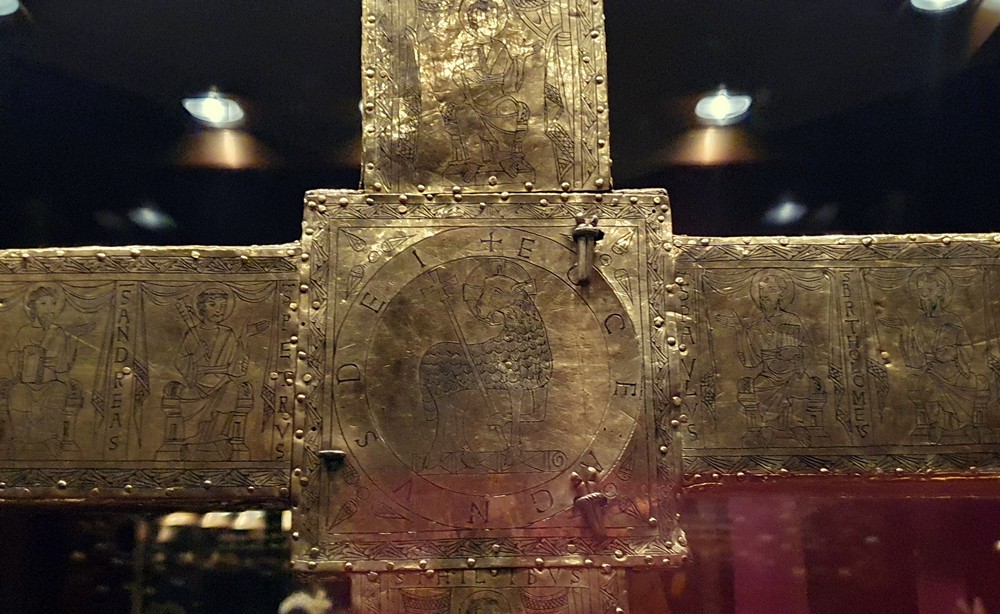
I was also intrigued by the cross because it also serves as a case for storing relics. In the Middle Ages, people perceived the Holy Roman Empire as a continuation of the Roman Empire under the rule of Christ, which is why we find religiously significant relics in the secular treasury. The front part of the cross can be dismantled to form a case that fits exactly over a piece of the “true” wooden cross displayed next to it. The horizontal arm serves to store the holy lance. For centuries, it was believed that this was the lance with which a Roman soldier pierced Christ’s side. However, a thorough analysis in 2003 showed that the lance was made later. However, a nail that is older is embedded in the tip of the lance, and it is therefore possible that that was the originally revered relic, as the nail with which Christ was nailed to the cross.
3. Cradle for Eaglet
Eaglet or aigion in French, was the nickname for the prince, son of Napoleon and Marie Louise, the eldest daughter of Austrian Emperor Francis II/I (the one with the crown on his head in the painting). The emperor allowed the marriage to secure political peace. Portraits of the couple in their wedding attire hang on the wall. On March 20, 1811, their son was born, and according to the tradition of the Holy Roman Empire, his father immediately granted him the title “His Majesty, King of Rome.” The city of Paris gave him this cradle, made of 280 kg of silver! However, it is only a ceremonial piece of furniture; a simpler wooden cradle was used to rock the baby.
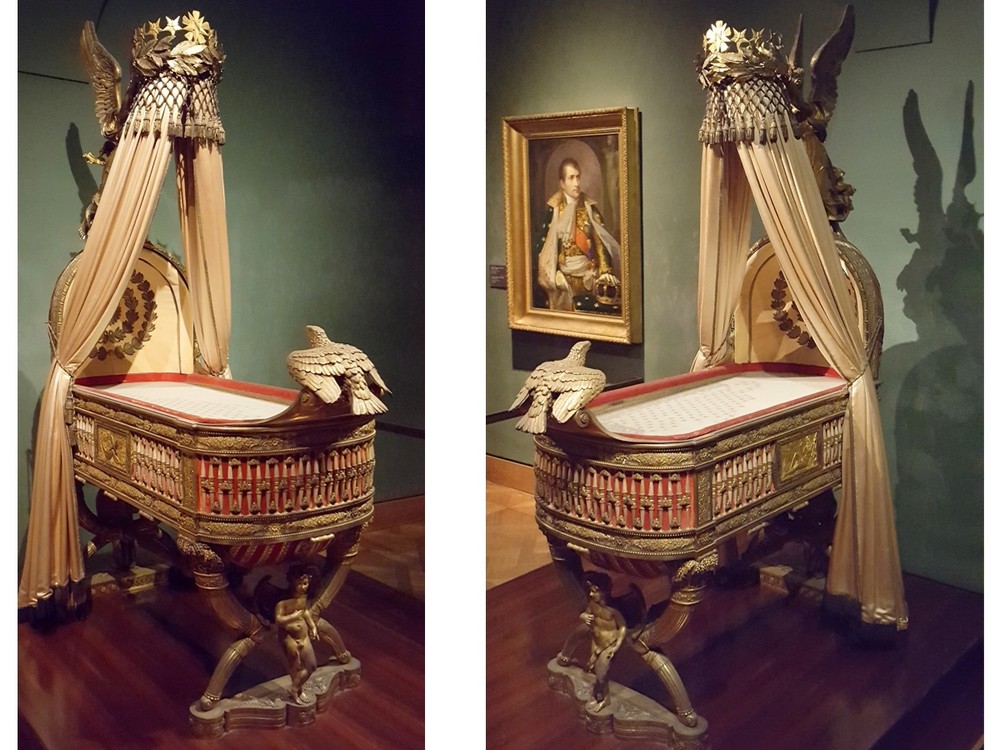
On the front, a young eagle is about to take flight toward a crown of stars. The winged figure symbolizes Glory and Victory. However, I was also struck by the eerie shadow that the cradle casts on the wall. It was as if it were a mysterious figure, predicting a bad future… After Napoleon’s defeat at Waterloo, Marie Louise returned to Vienna with her son and the cradle. The prince contracted tuberculosis and died at the age of 21 in Schönbrunn Palace…
4. Christening Set
When a child was born at the imperial court, a christening had to be held no later than one day after its birth. However, this was not just a family affair, but literally a solemn state ceremony. The christening took place in a special room in the residence where the child was born (in Vienna’s Hofburg, Schönbrunn or Laxenburg). The baby had to be dressed appropriately for such a ceremony. A christening set was designed for this purpose.
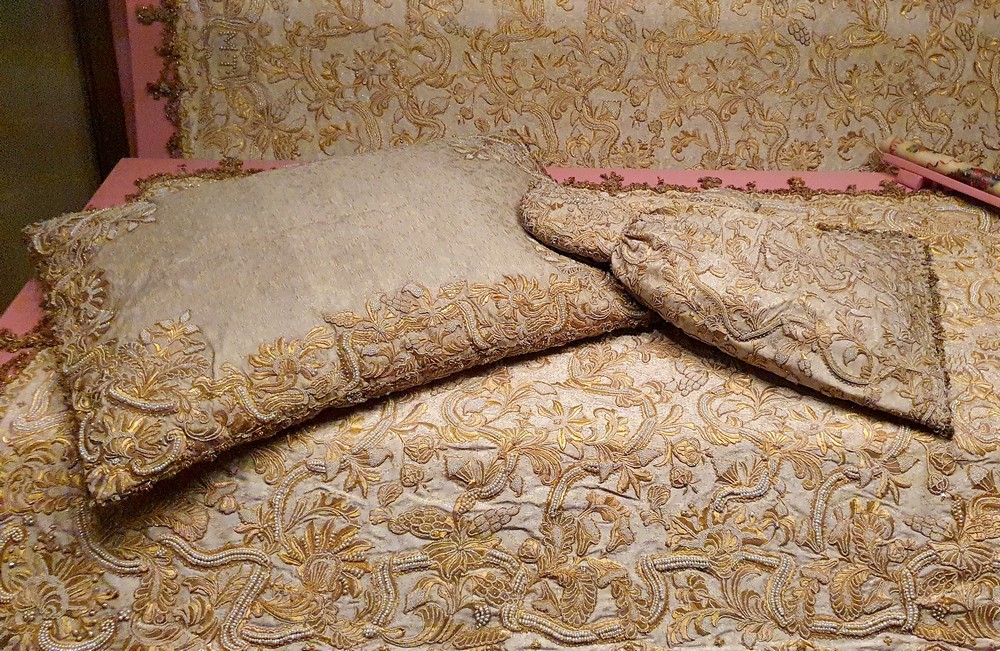
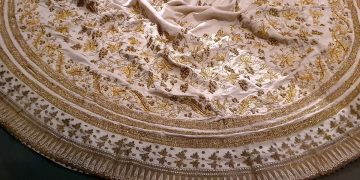
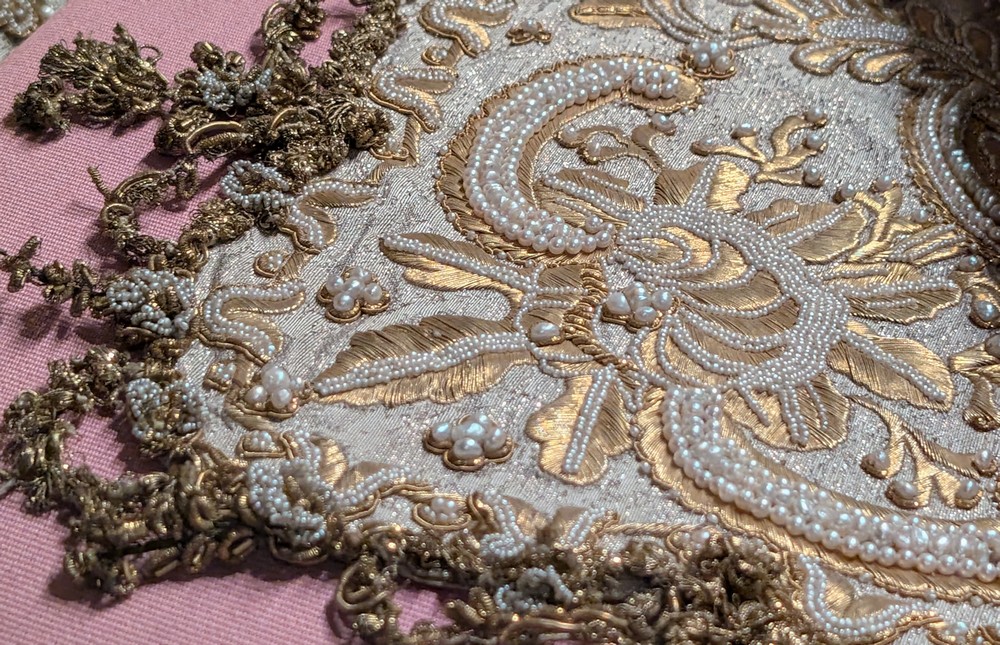
This christening set on display was donated to the treasury by Maria Theresa. It was used only once – at the christening of her granddaughter, the daughter of Joseph II, who was named after her grandmother (the child sadly died at the age of 8). The entire set is richly and beautifully embroidered with gold and silver thread and decorated with pearls.
5. Kolana – Knight’s Chain of the Order of the Golden Fleece
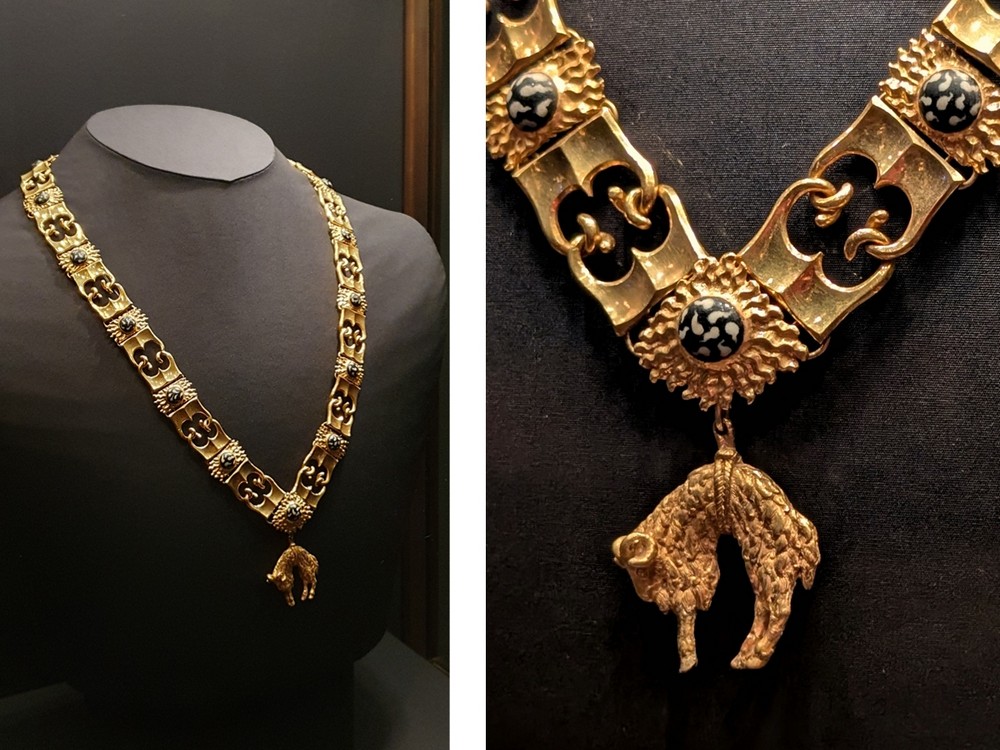
The Catholic Order of the Golden Fleece was founded by Philip III, Duke of Burgundy, in 1430. Even today, it remains one of the most prestigious and historically significant orders of knighthood in the world. The knight’s chain is made of solid gold, weighs around 400 g, and is therefore worn only on ceremonial occasions; otherwise, the chain is replaced by a red silk ribbon. The chain is not worn around the neck, but on the shoulders (small hooks are sewn onto the clothing).
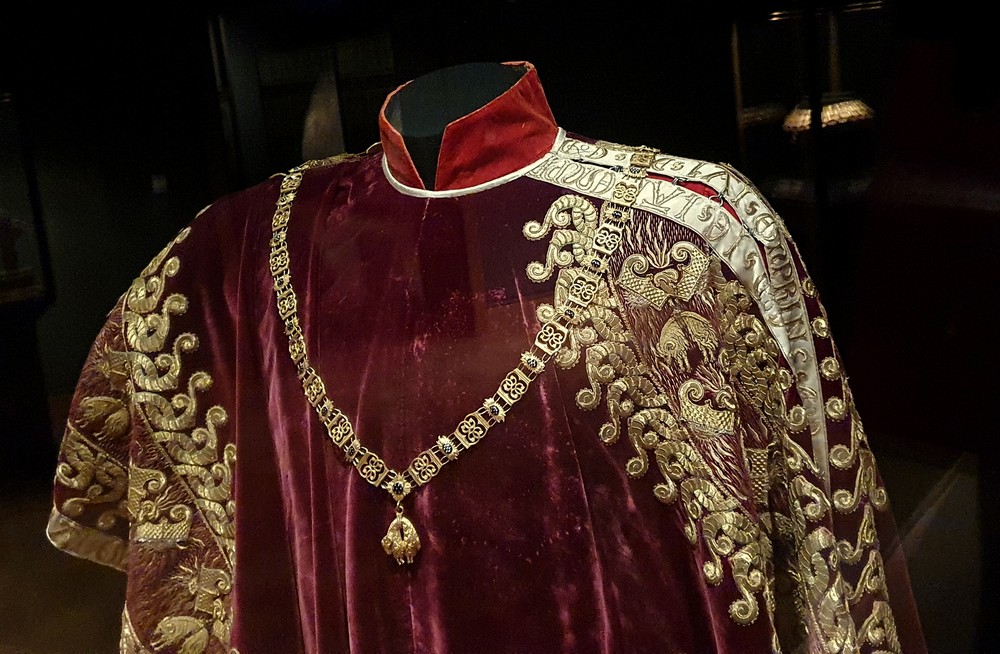
The symbol of the order, a ram‘s fleece cast in gold, hangs from the chain. Another decorative element is a flint stone (black with white dots, made of enamel) from which short golden flames shoot out.
For centuries, the entire treasure of the order had been stored in Brussels. To protect it from damage during the French Revolution, all items were transferred to the Austrian monarch in Vienna, where the treasure (the cross of allegiance, the golden chain for the herald, robes, badges, and historical relics) is still stored today.
6. Liturgical Vestments of the Order of the Golden Fleece
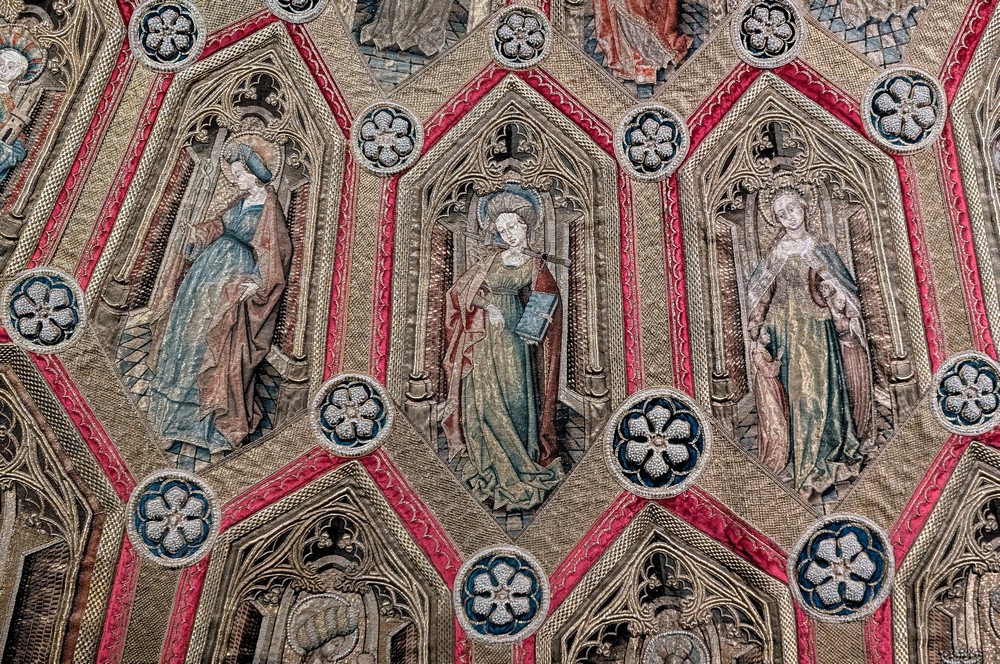
I admit that during my first visit to the treasury, I did not pay enough attention to this exhibit. It was only later that I learned that these are the most beautiful and significant embroidered textiles ever made in Europe!
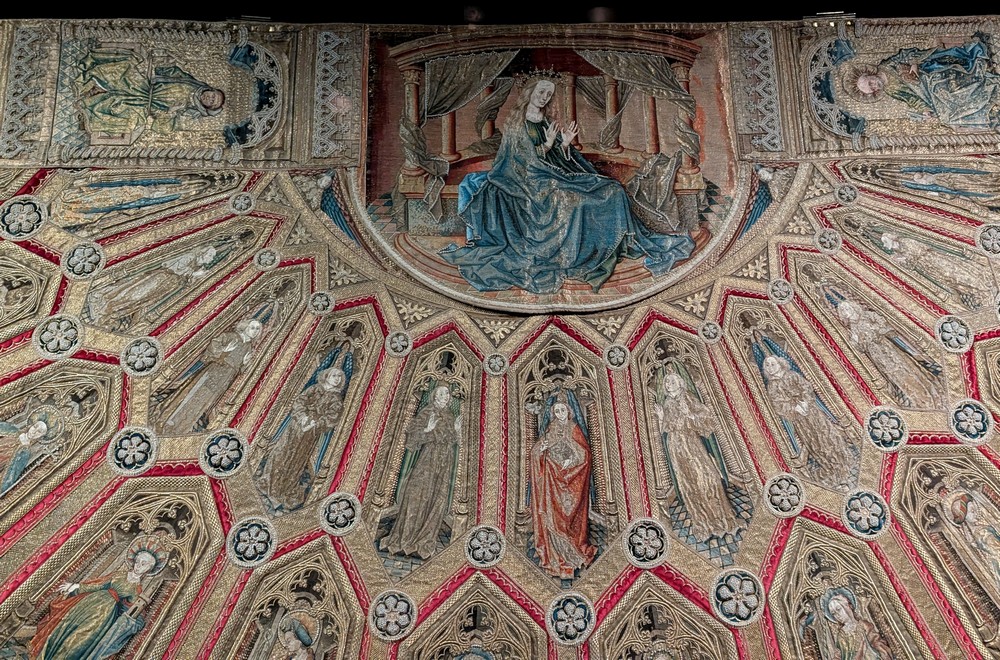
Solemn religious ceremonies also require special vestments. Two embroidery techniques were used to make the chasubles, tunics, liturgical vestments and altar hangings:
1. needle painting – a large number of stitches with colored silk threads placed close together to create the impression of a painting (skin, hair, fur trims on garments)
2. nué embroidery – gold threads are placed horizontally very close together on the base and then sewn vertically with colored silk thread. This creates an effect of light and shadow.
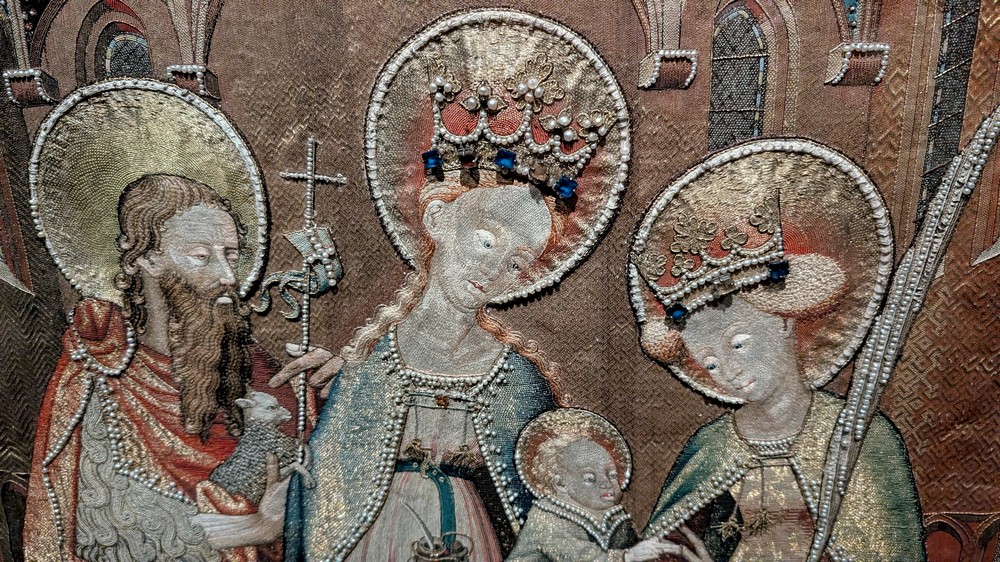
Pearls and colored glass beads add a sparkling sheen to the embroidery. This type of embroidery is extremely expensive and time-consuming. The three-dimensional space and folds in the clothing are depicted in an amazingly convincing manner; very fine painters were apparently also involved in the creation. Interestingly, none of the eight pieces on display contains the symbols of the order. They were probably originally created for the founder, Philip III the Good, who later donated them to the order.
7. Golden Rose
A gift given by the Pope to important ladies, churches and ecclesiastical institutions to encourage their active work for the Church.
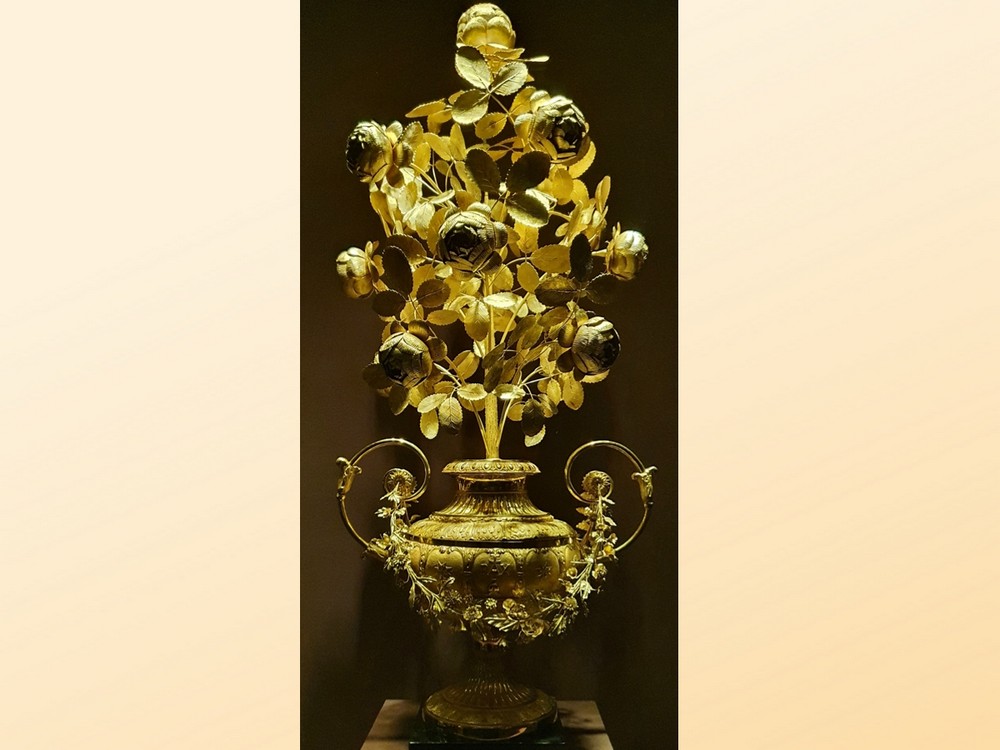
This bouquet of golden roses was consecrated by Pius VII and sent to Empress Caroline Auguste, the fourth wife of Emperor Francis II/I. The Empress devoted herself to caring for young people, helping the poor and sick, and establishing foundations in Graz, Salzburg and Prague to support them. The top rose (symbol of Christ) is hollow so that it can be filled with fragrant musk and balm.
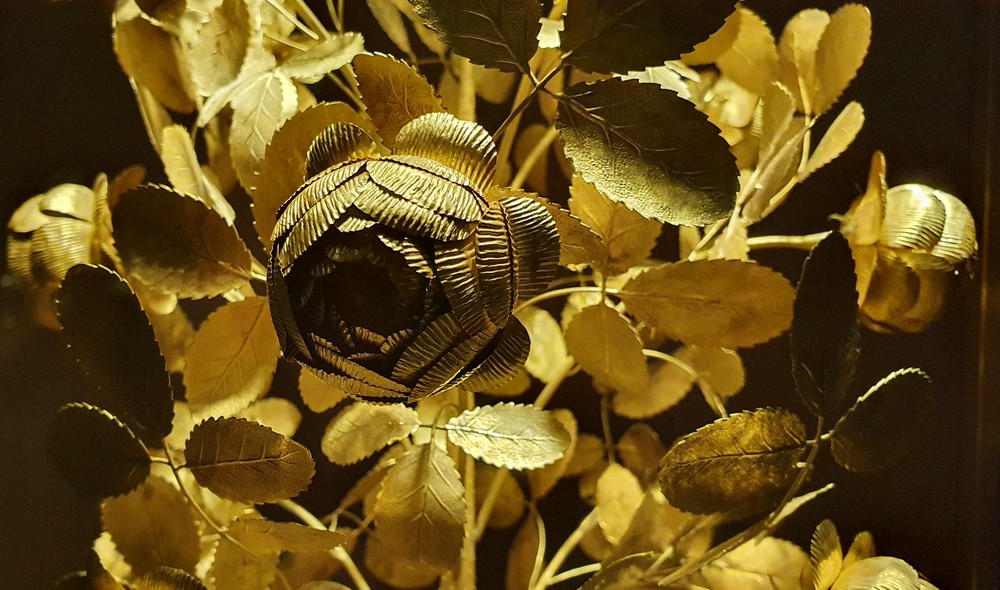
8. Opal Jewellery
This jewellery has special value for me because the beautiful opals that adorn it come from what is now Slovakia, my homeland. Opal was revered in the Middle Ages as the “stone of stones” because, in addition to its radiant power, it concentrates the colors of other gemstones. The most beautiful specimens were mined in the Libanka mine (Eastern Slovakia).
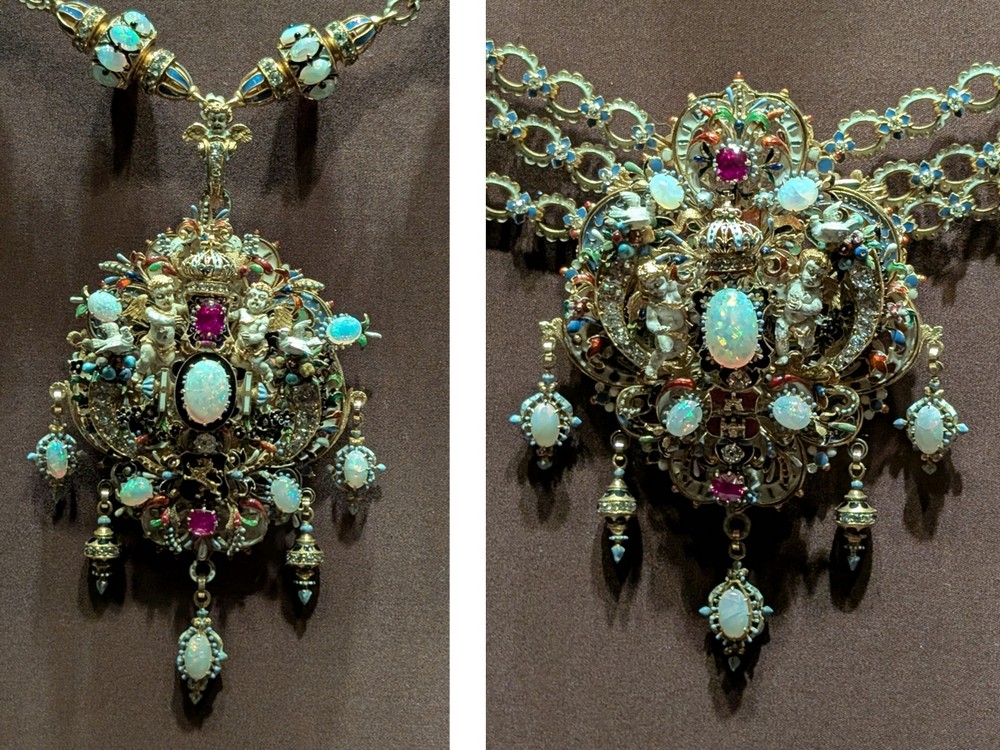
Princess Stephanie received this set of beautiful, delicate jewellery from the city of Budapest for her marriage to Crown Prince Rudolph. When she remarried after his tragic death, the jewellery returned to the ownership of Emperor Franz Joseph, who stored it in the treasury.
Incidentally, there isn’t much jewellery in the treasury. The last emperor, Charles I, took several pieces with him into exile in 1918, and they have never been found again. Not even the crown made for Empress Elisabeth (Sisi) on the occasion of Franz Joseph’s coronation as King of Hungary.
9. Emerald Unguentarium
I like the color green, which is perhaps why I am fascinated by this huge emerald from the Muzu mine in Colombia. It is actually two pieces that have grown together. We have already seen how good Emperor Rudolf II’s taste was. And it was probably he who bought this emerald for the treasury.
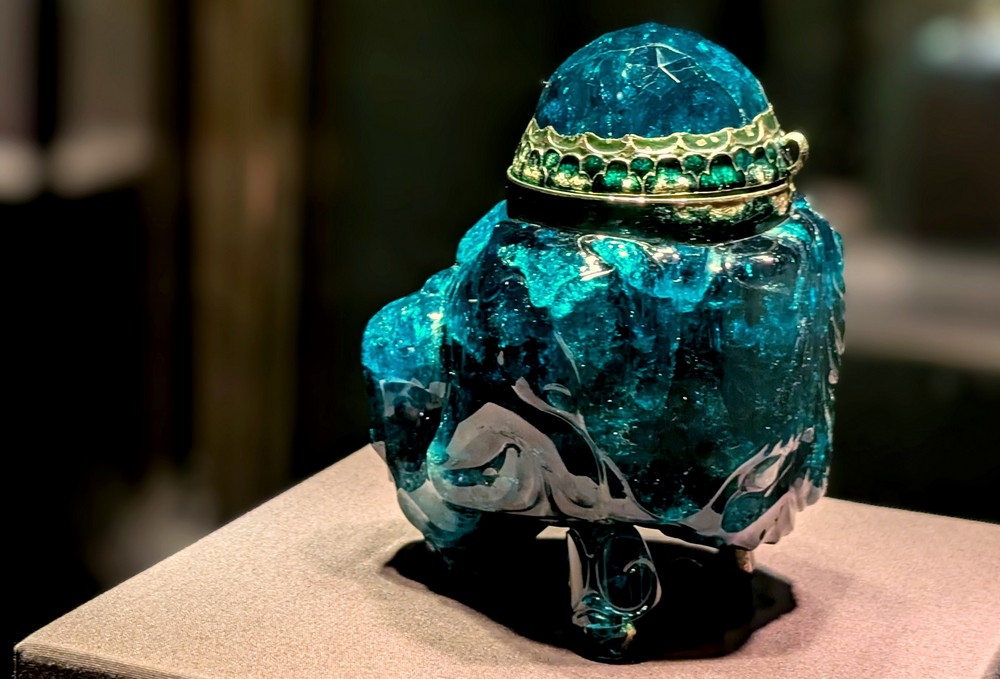
Later, however, Emperor Ferdinand III liked the stone so much that he decided to have it made into an unguentarium, which is a Latin word for a small bottle used in ancient times to store fragrant oils and ointments. The emperor commissioned the Prague jeweller Dionysius Miseroni to make the container. Miseroni tried to preserve the natural irregular shape of the stone, but unfortunately, a large amount of material was lost. The fragments left over from the cutting of the emerald were also brought to Vienna with the container. Jewellers reportedly offered astronomical sums for them.
I believe that when you visit the Imperial Treasury, you, too, will choose items that interest you the most.
Practical information for visitors: HERE – closed on Mondays! Online tickets: HERE
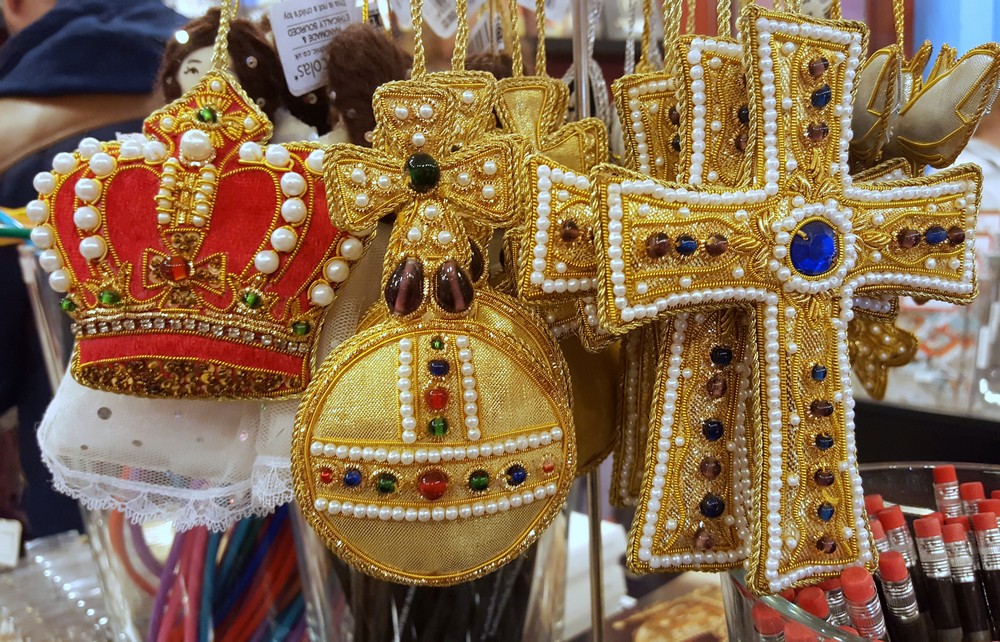
Don’t forget to stop by the treasury shop, where you might find a decoration for your Christmas tree!
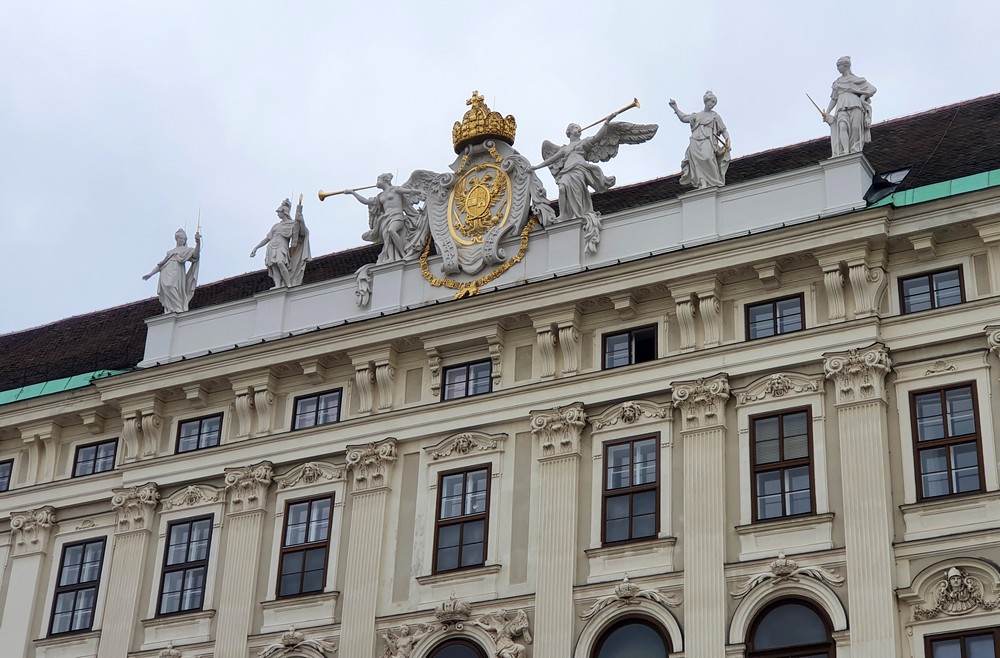
When you leave the Treasury and find yourself back in the courtyard, where you will see the statue of Emperor Francis II/I in front of you, look up at the roof of the right wing of the Hofburg. There, you will find the gilded imperial crown with the chain of the Order of the Golden Fleece.
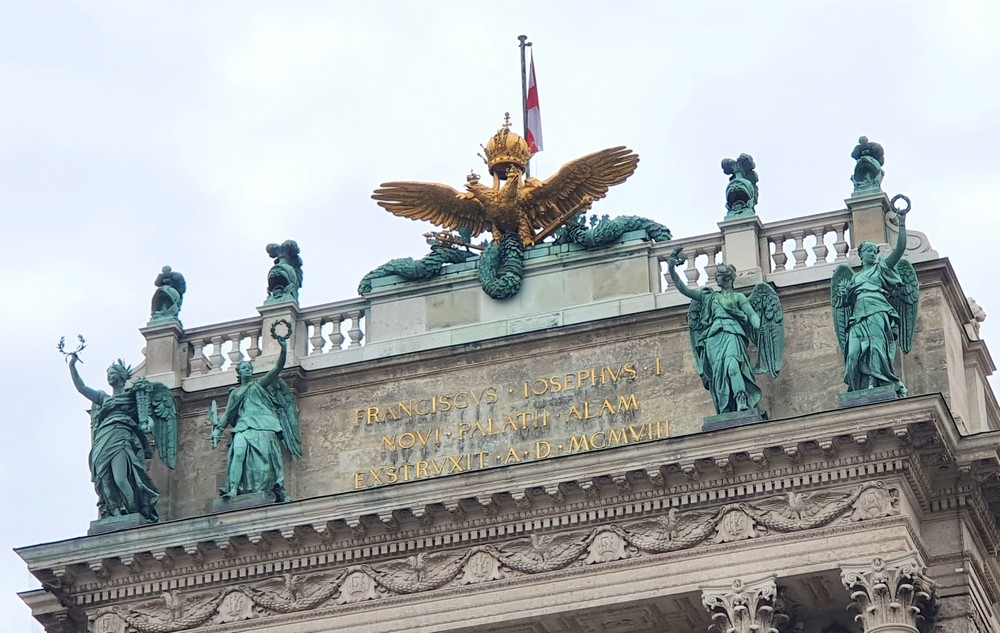
And when you walk out onto Heldenplatz, the portal above the entrance to the National Library and Papyrus Museum is decorated with the Austrian (Rudolf´s) crown!
I am sure that as you walk around Vienna, you will notice various depictions of these crowns in many other places.
Text: © Copyright Ingrid, Travelpotpourri
Fotos: © Copyright Ingrid, Travelpotpourri