
 TRAVEL



 RECIPES WITH A STORY












 AUSTRIA-VIENNA


 SLOVAKIA-BRATISLAVA


 EVENTS

 INTERVIEWS


The town of Admont in the Austrian federal republic of Styria lies in the Alpine valley of the Enns river. Even at the beginning of July, the surrounding nature was coloured in deep green and the majestic mountains in blue, haze rose from the forests, a large herd of doe stood near the road and cows lay contentedly on the grass. Even from a greater distance, two towers could be easily recognized which, like sharply cut pencils, rose their tips into the sky.

These are the towers of the church which is part of the Admont Abbey. For almost a thousand years, the monks of the Order of St. Benedict have been living here. Their basic motto is Ora et labora – Pray and work! though here in Admont it is undoubtedly supplemented by “et lege” – and read!

Ora – Pray!
The Abbey of St. Blaise in Admont was founded in 1074 by Archbishop Gebhard of Salzburg, from where the first monks came to the new monastery. Of course, the monastery is first and foremost a center of the faith, therefore the main task of the monks is to pray. Every day, they meet four times for common prayer, for prayers concerning the most pressing problems of the contemporary world. Today, when humanity is being severely tested by a pandemic and its consequences, we can easily imagine the direction these prayers are going.

In almost a thousand years of history, various abbots took turns, mostly scholars who wrote scientific works, supported the arts, founded schools and gradually expanded the monastery complex. The dominant feature of the abbey is the monastery church. Before entering, the head should be tilted back properly, the one who has a good eye may notice that one tower is a little (1 meter) higher. On the portal, St. Benedict and St. Scholastica invite to prayer, while at the spire, there is a statue of St. Blaise, the patron saint of the church and the abbey.


The current church, one of the first Neo-Gothic sacral buildings in Austria, is actually the fifth one at this place. Only part of the choir and a side portal of the original buildings remained. The previous church was destroyed during a great fire in 1865. The interior of the church is impressive – high, narrow vaults, five side chapels, altars with wooden statues – on the Marian altar a picture of the Immaculate Mary and around it, 15 carved rosary medallions by sculptor Josef Stammel (we’ll hear about him later), which partly escaped the devastating fire.

Labora – Work!
St. Benedict wrote in his rules that idleness is the enemy of the soul. Therefore, he encourages his followers to do manual work. And in such an abbey, with an area of more than 12 hectares, there is always more than enough work. As befits a proper monastery, there is also a garden, a pond, a chapel, four museums, a secondary school (600 students), even a football field and, of course, a library. In addition, his administration includes 27 parishes. At present, there are 21 monks in the monastery, two-thirds of them under the age of 25, working as priests and teachers, taking care of the museums, the collections, the library and the archive. And when water and forestry, painting and restoration workshops, a wine shop, a pharmacy, a health center, a home for elderly people, a kitchen, accommodation for monastery guests and other premises are added to this, it is clear that they would not be able to do it alone. The monastery employs 500 people and is the largest provider of jobs in the area, so we can safely say that it is not only the spiritual and cultural but also the economic driving force of the region.


There also used to be a blacksmith’s workshop from 1764 here but it fell victim to the great fire as well. Metal objects on the wall in one part of the complex are a reminder of this workshop and a demonstration of the wonderful skills of Styrian craftsmen.

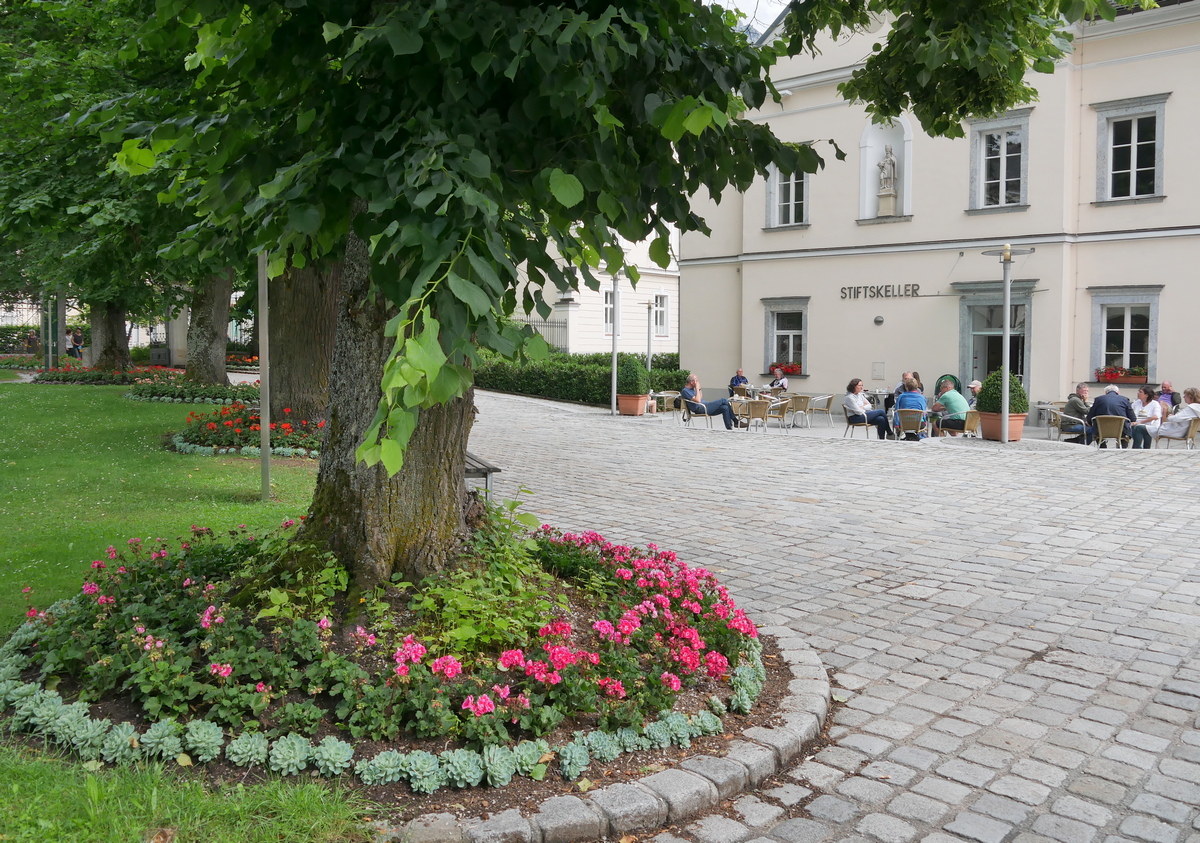
The effect of human work can be seen, for example, in the beautiful garden architecture. There are huge linden trees in the area – I really liked the large circles with planted geraniums and other flowers around them. A pleasant sitting or walk is also offered in the monastery garden, although in some parts it looks more like a wild meadow. A swan couple also enjoyed to stay here, they presented us their eight “ugly ducklings” on a nearby pond.


Prayer and work are said to be a means for monks to overcome the enemies of the soul. However, every visitor to the monastery takes home a lesson from here as well. We live in a hectic time, we can’t catch up, we are pressed by deadlines. That is why we should try to find a rhythm in our lives, a balance between work and rest. For some, this rest can be a prayer, for others, the opportunity to slow down time and themselves, and at least for a while, to admire the world around us, to listen to silence, and thus touch sacred eternity.

Lege – Read!
However, the pride of the Admont Abbey is undoubtedly the library. Father Prior Maximilian is the abbot’s deputy and also a librarian and archivist. He was slowly opening a large white door in front of us and when we all almost unanimously let out a loud wow! his face glowed with satisfaction, despite being half-covered by a face mask. We reacted exactly as was already expected of visitors almost 300 years ago. Large and richly decorated rooms, 14 meters wide, stretched to a length of up to 70 meters. Thanks to these dimensions, we had just entered the largest monastery library in the world. It was designed by architect Joseph Hueber and finished in 1776.

Wooden shelves in similar libraries are mostly brown but in Admont, they are painted white and decorated with gilded wood carving. In addition, light penetrates into the space through 48 windows, so the overall picture acquires a heavenly grandeur and harmony. All the ceiling frescoes depicting the stages of human knowledge were painted by Bartolomeo Altomonte.


And there were shelves full of books everywhere, even in the galleries. Our guide tucked a key into a fake book, opened the entire bookshelf and revealed the wooden stairs to the gallery. All four staircases are hidden in such a way that they do not disturb the artistic perfection of the library space.
The central part of the library is higher, where various editions of the Bible and other important religious texts are stored. The bronzed wooden statues by sculptor Josef Stammel (like in the church) symbolize the Last Four Things. Father Prior said he would explain one of them, leaving the choice to us. We wanted Heaven, but he just dryly remarked that it was the most boring statue, and began to explain the sculpture of a sinner sitting on the shoulders of a strange monster depicting Hell. It is unbelievable how many symbols this statue contains – eternity, the seven greatest sins, but there is also a small worm that bites the man’s chest with the same intensity as bad conscience…

The monastery library has over 200,000 books, 70,000 are stored in these representative rooms. Paradoxically, books have never been read here. These rooms were used only for the representation and storage of books. Father Prior sighed that he had one of the most beautiful workplaces but also one of the most impractical ones. He pulled a book from 1794 from a shelf, in which the author describes nature and animals, but two hundred years ago he had to make use more of his imagination than of his own experience. And so the book depicts an elephant not only as we know it, but also a white, a black and even a spotted one! The stamp on the inside reveals that it is one of three thousand books taken from the monastery by the Nazis. These were mainly medical publications that served as inspiration in conducting various experiments on prisoners in concentration camps. There is a stamp from Dachau on this book. Fortunately, the pedantic Germans had made an exact list of where the books had been confiscated from, so after the war, this one returned to Admont.


The library also has 1400 manuscripts and 530 incunabula (first editions until 1500). In addition to theological books, there are also books on law and medicine, lexicons, tales and travel diaries – for example, one of the oldest editions of Marco Polo in German from the 14th century.

The rarest object are two fragments that fit into a small envelope, known as the Abrogans. It was originally a Latin-Latin dictionary, which means that unusable Latin expressions were translated into usable Latin words. In the middle of the 8th century, someone had the idea to add a third column of German translations to the dictionary. Although the original dictionary has not been preserved, there are four manuscripts that were written around the year 800 – today, they are stored in the libraries in St. Gallen, Paris, Karlsruhe and Admont. Father Prior emphasized that these two small pieces of parchment are the oldest written find using German on Austrian territory, and carefully put the rare relics back into the envelope. Finally, he mentioned how he enjoys watching linguists having an incredibly long debate about why an unknown scribe has added an extra wedge to a letter, and conspirators discussing over why words starting with a C and D have been found here…

The library is open from 1 July to 30 October (2020 season) from Wednesday to Sunday and on public holidays from 10:30 to 15:30. More information about opening hours: here and ticket prices: here
Unique Digital Tour
How do we get to the gallery? Why can’t we look at the frescoes on the ceiling up close or browse at least through one book? Similar questions are repeated at almost every tour of the library. In order to meet such demands of the visitors, the unique digitization of the library had begun last autumn – unaware of how important this project was going to be when all cultural institutions closed due to the pandemic a few months later. A special platform – cultour.digital has been created so that for a small fee, one can access great art – for the first time, one can walk through the library through the highest resolution images currently available, admiring its architecture, frescoes and sculptures, uncovering hidden staircases and visiting the galleries. The project also allows a preview of one hundred selected books, in which you can browse page by page. Watch a short demo, although, unfortunately, in limited quality.
Practical information:
Where to stay:
During our visit, we were accommodated directly in the monastery. The rooms are named after different saints, I had St. Paul.


The room was large, the equipment new, although simple (no TV, but WLAN yes), the bathroom was new and modern as well. That I was in a monastery was evident by the cross hung above the door, the spiritual literature (also the rules of St. Benedict), the vessel on the wall for holy water, which was prepared in a bottle on the table. The welcome leaflet began with a greeting Pax! (peace) and contained not only practical information like in other accommodation facilities but also a list of the most important pillars of the Christian faith. As an added bonus – almost no light pollution after dark and amazing silence!
More information about accommodation options: here
Where to eat:
For example, in the Stiftkeller restaurant directly in the abbey complex. The chef is Jozef from Slovakia, my home country. Well, the world is small… You can order, for example, monastery soup (a potato cream one), Benedictine plate (grilled turkey cutlet with mushroom sauce) and even monastery coffee (with milk foam, whipped cream and caramel) and taste wine from the Dveri Pax winery, which also belongs to the monastery. For soft drinks, I recommend tasting Bergfex (a combination of mint and gooseberries). For those who begin dining with prayer, Bibles and prayer books are set up in the windows.


Guests staying in the monastery have the possibility to eat in a dining room – a smaller choice of meals and only cold dinners on weekends.
Extra tips:
While the library is housed in one of the abbey wings, there are four other museums in the other sections:
Cultural-Historical Museum – paintings, glass windows, statues and various liturgical objects from the Romanesque period to the Rococo
Natural History Museum – a huge collection of insects, more than 250,000 exhibits
Museum of Modern Art – artists have been invited to the monastery for a constructive dialogue for the last 20 years, the works of art that have been exhibited here today were created during/after these meetings

The Gothic Museum was the only one open during our visit. Definitely worth a visit, on a grey background and with good lighting, the exhibits stand out wonderfully and the exhibition perfectly completes the overall experience of visiting the abbey. Kuno Erich Mayer is an Austrian businessman in the fashion industry and at the same time an admirer and passionate collector of medieval art. One day, he decided to donate his collection to an institution where others could admire it as well. He marched all over Austria until 2017 when his decision fell onto the abbey in Admont.

The Gothic Museum currently exhibits 85 statues and altarpieces that arouse admiration and humility today as they used to several hundred years ago.
I was most impressed by the gentle Madonnas, but also St. Catherine whose high education the author of the sculpture had indicated by the fact that the saint not only holds a closed book but her fingers are rested between its pages. Very strange is the statue of Mary Magdalene with an almost male body, even hairy, I had never seen a similar statue.

The figures of little Jesus in various sizes, once popular as gifts for nuns, who dressed them in precious gowns, looked like nostalgic dolls.

If you want to buy a souvenir from your visit to the monastery, you must definitely go to the museum shop. Here, you will find rosaries, crosses and other similar items, marzipan and chocolates made especially for Admont Abbey. For those who prefer liquid souvenirs, part of the room is reserved for a wine shop with a rich selection of wines from the winery Dveri Pax in Slovenia, where Benedictine monks from Admont have been producing wine since 1139. Their wines have won several international awards. Tasting is also possible in the shop.

Pilgrimage Place
6 km from Admont, there is Frauenberg hill (130 m above sea level), on which you will find the pilgrimage church Mariä Opferung – a Gothic building with an interesting facade decorated with slag.


Pilgrims have been coming here for 600 years to beg for their pious wishes in front of the statue of the merciful Virgin Mary. Some also let their prayers take effect in the chapel in the upper garden.


The church has ten bells. When they are heard in the valley, it is said to be the strongest ringing in the whole of Upper Styria (I can’t confirm because they just didn’t ring during our visit).
The complex is complemented by a Baroque Calvary, from where there is a beautiful view all the way to Admont.
More information about Admont Abbey, as well as an overview of upcoming events (concerts, picnics, fairs, wine festival, Advent), can be found in English: here

Note: all opinions expressed in this article are my own.
Text: © Copyright Ingrid, Travelpotpourri
Photos: © Copyright Ingrid, Travelpotpourri

Thanks to Klösterreich for organizing this visit to Admont Abbey.
Admont, Steiermark, Austria