
 TRAVEL


 RECIPES WITH A STORY









 AUSTRIA-VIENNA



 SLOVAKIA-BRATISLAVA

 EVENTS


 INTERVIEWS


The historical center of Timisoara is represented by three town squares, each unique, each of a different size and shape, and each with its own architectural gems. In the Day 1 Article, we walked around Victory Square as well as Liberty Square and then we reached the third square through Vasile Alecsandri Street. It is the Unification Square. Before entering its pavement, do not forget to notice an interesting corner house at the end of this street on the left. It is the Miksa Steiner Palace – in Timisoara, historic houses are named after their original owners. This house belonged to the wealthy businessman Steiner.

The local people call this house the Gingerbread House, although it is not gingerbread brown in color, but is all white with pale and dark blue ornaments. It is also known as the Discount Bank Palace as it is the headquarters of this bank. The building is a unique example of Hungarian Art Nouveau, designed in 1909 by architects Dezsó Jakab and Marcell Komor. The beehive motif recalls the building’s original function as an apartment building.

And now we are standing at one of the four corners of the rectangular, huge Unification Square – Piata Unirii (150 x 110 meters). It was named after the event in 1919 when the Banat region joined Romania. It is the oldest square in Timisoara and at the same time, the largest complex of Baroque architecture in the city. At the beginning of the 20th century, food and animal markets were held here until 1969.

The highlight of the square is an artesian well – 400 meters deep, mainly it is the Plague Column of the Holy Trinity, commemorating the plague epidemic in the entire Banat region between 1731 and 1738. The epidemic was brought here by the Austrian imperial troops; among the victims in Timisoara, there were even six mayors of the city.
The column with statues of several saints was created by the famous Austrian sculptor Georg Raphael Donner and was also sent from Vienna to Timisoara via the Danube-Tisa-Bega canal river route.

The Roman Catholic cathedral can be seen behind the column on the left in the photo, which is why this square is sometimes called Cathedral Square. The Baroque St. George Cathedral was built in the years 1736-1774. The first plans were drawn up by Joseph Emanuel Fischer von Erlach, who was then the director of the Imperial Construction Office in Vienna (by the way, he was the son of Johann Bernhard Fischer von Erlach, the most famous Austrian Baroque architect).

There are nine Rococo and Baroque altars in the cathedral, which were created by various renowned artists. The main altar was painted by Michelangelo Unterberger, at that time director of the Vienna Academy of Fine Arts. The organ, installed in 1903, is from the workshop of Austrian maker Carl Leopold Wegenstein.
Outside, on either side of the cathedral is a row of houses with restaurants on the ground floor. It is a very pleasant place to sit – both during the day and in the evening, when one can enjoy a casual evening, without hurry, in a relaxed atmosphere after so many steps taken around the city. On the right, you will find my favorite restaurant in town (house no. 13!): In Thyme

A very pleasant interior, but we always sat outside. The service was fine, the food excellent, coffee, wine and strawberry lemonade as well and the prices acceptable. Above all, we had a view of the entire square, where sometimes very interesting things happened.

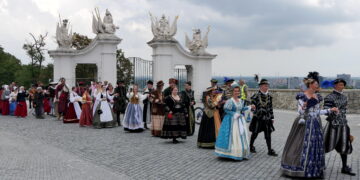
For example, we saw some groups in medieval costumes, one was dragging an old cannon with them and even shooting it in the square!
From the table, we could also see the Museum of Art, which is located in the Baroque palace. In the past, the building served as a residence for Austrian emperors when they were in Timisoara – for example, Emperor Jozef II. spent the night here in 1767 and Francis Joseph I in 1872.
At the corner of the square opposite the restaurant, the richly decorated building of the Serbian Orthodox Bishop’s Palace attracts the attention of Timisoara visitors. With its white facade, it reminded me of a whipped cream cake. Initially, the building looked very simple, the first decorative element was a rich bas-relief, which stands out on the facade even today.

The back part of the Serbian Orthodox Cathedral can be seen next to the palace. The original church burned down during a plague epidemic, the current cathedral was built in its place – at the same time as the bishop’s palace. The building is worth a visit, the interior is richly decorated and the ceiling and walls are nicely painted.

The fact, that there are churches of different religions at the same square or close to each other also reflects the multicultural character of Timisoara.
However, the most photographed object on this square is the Brück House, built in 1911 in the Hungarian Art Nouveau style, as evidenced by the folklore ornaments on the tiles. It is again one of the buildings designed by the star architect of the city, László Székely (other of his buildings are mentioned in the Day 1 Article). Already at the end of the 19th century, there was a pharmacy on the ground floor and the house was called the Golden Cross. However, the house including the pharmacy was later bought by the businessman Salamon Brück who (modestly…) named the house after himself. Currently, there is still a pharmacy in the house, even with the original furniture and display cases. While the bishop’s palace reminded me of a cake, some say that Brück House looks like a thin slice of pie.

I think we have already spent enough time getting to know the interesting architecture of Timisoara – but what fascinated me most is how much the monarchy had invested in this city, what important personalities – artists and architects – have given the city an unmistakable character, and I understand more and more why Timisoara is also called Little Vienna.
That – however – is not the only nickname. Timisoara is called the City of Flowers or the City of Parks as well. The whole city is intertwined with parks and gardens. It is definitely worth visiting at least some of them if only to recharge your batteries for further walks around the city.
I visited the Botanical Garden. I admit that the garden has not excited me that much, although a walk among local, Mediterranean or tropical plants on a hot day was pleasant. It also reminded me of a famous celebrity who was born in Timisoara. It was Johnny Weissmüller (1904-1984), whose family went to the USA, Johnny became a swimmer and an actor – the first and most famous representative of the movie Tarzan.

One of the most beautiful flower oases is definitely Rose Park. It was opened in 1891 on the occasion of an agricultural-industrial exhibition. The park was designed by landscape architect Wilhelm Mühle, who was born in Chlumec in Czechia but settled in Timisoara, where he established the largest rosary – over 2,000 different types of roses from the Balkan region.

His collection of roses made a great impression on Emperor Francis Joseph I, who visited the park the year it was opened. The Emperor awarded Mühle not only with the Golden Cross but also the title of Royal and Imperial Supplier (k.u.k.).

Mühle exported roses not only to Vienna but also to Budapest and opened the first specialist shop in Timisoara (we mentioned it near the “umbrella” street in the Day 1 Article). The family tradition was continued by his son Arpad, who initiated the reconstruction of Rose Park after the First World War. There is a summer theater in the park as well, where various concerts and festivals take place.

By the way, opposite Rose Park on the other side of the road (Michelangelo Street), there is also a large children’s park, which was also ceremonially opened in 1891.
To get new energy, you can sit on the banks of the Bega River or in a cafe on one of the parked boats, order a cold drink or ice cream and enjoy the surrounding lush greenery.

After gaining enough energy in one of Timisoara’s parks or gardens (the choice is wide), we will go for one more walk in a less visited part of the city. To save time and our legs, we can take the tram there. Timisoara trams are just as much an experience – some are new, some are old, shabby – just like the historic houses in the city. Finally, don’t forget that Timisoara was the fifth city in the world where a horse-drawn tram started operating!

We need tram no. 6, we can get on at the stop at Liberty Square. I was lucky that, as part of the European Capital of Culture project, a tram that was decorated by Mexican artist Carlos Amorales with thousands of butterflies made of black paper ran along this route. It was fun to watch how the people reacted with surprise to this unconventional decoration.

I took the tram to the Fabric district. This part has received its name from the many manufactories, craft workshops, guilds and mills established here during industrialization. The center of the district is Trajan Square – Piata Traian.

It is actually a smaller version of the Union Square. Dominating the square are the Serbian Orthodox Church of the Great Martyr St. George and the Art Nouveau Palace Mercur, named after the sculpture on the roof. However, the houses in this square are crying out for reconstruction even more than the buildings in the aforementioned squares of Timisoara.

I also discovered the Catholic Millennium Church here, where I was fascinated by the beautifully painted walls with geometric and plant motifs.


The reason why I went to this part of the city was the Fabric Synagogue – for me, one of the most beautiful buildings in Timisoara.

It was built in the years 1897-1899 in an eclectic style with a Moorish influence according to the project of the Hungarian architect Lipót Baumhorn, who was nicknamed the “father of synagogues”. Although he has also built the Lloyd Palace at Victory Square in Timisoara, he mainly specialized in synagogues throughout the monarchy. He built 20 of them – in Lučenec and Nitra (Slovakia), but also in Ostrichom, Szeged and Budapest (Hungary) and Brasov (Romania).

Most of the Jews left the city after World War II and immigrated to Israel. The synagogue was closed in 1985 and has been falling into disrepair ever since. With an uncertain feeling, I climbed the dilapidated stairs so that I could at least look a little inside the open door through the grille.

After that, I walked back to the city center along 3 August 1919 Boulevard and I was still amazed at the interesting Art Nouveau buildings, built around 1900, which lined both sides of the street. Perhaps there was a sign on each of them stating that it was a cultural monument. However, most buildings are in poor condition and awaiting reconstruction. I will mention at least one of them – Miksa Steiner Palace. Max Steiner had become rich thanks to his factory for the production of spodium (bone coal). In the city center, he built the aforementioned residential house and here, in the Fabric quarter, a palace, which after its completion was declared the most beautiful building in all of Timisoara.

Decebal’s Bridge over the Bega River is located here as well. Built in 1909 with a length of 195 and a width of 9 meters, it was the largest concrete bridge in Europe at the time. According to many, it is the most beautiful bridge in Timisoara even to this day.

If you have time and nice weather, then it is also worth visiting the Banat Village Museum. It is an ethnographic open-air museum on an area of 17 hectares with 52 peasant farms and houses of various nationalities that inhabit the Banat region. There is also a town hall, a school, a pub and, the highlight of the exhibition, a wooden church from 1746.
As I am from Slovakia, I was interested in the Slovak house. It is a Slovak farmhouse from Nadlak, built by folk craftsman Michal Bujtáš. My compatriots have been living in Romania for three centuries. Their migration took place in several waves, but they did not have to cross borders because they moved within the Austro-Hungarian Monarchy, their homeland at the time. There were once as many as 800 such houses in Nadlak, but the Romanian communists destroyed them all during collectivization. Most of the houses in the open-air museum are closed, but the Slovak house, you can also seen from the inside.

In the open-air museum, each nationality has its own tree – a Slovak linden grows next to a Romanian sour cherry.

The museum is closed on Mondays. The best way to get here is by car or bus no. 46 from the bus station (it is the final stop, the bus turns around and goes back to the city). More information: Muzeul Satului Bănățean
Read also:
Text: © Copyright Ingrid, Travelpotpourri
Fotos: © Copyright Ingrid, Travelpotpourri

Temešvár, Timiș, Rumunsko