

 TRAVEL



 RECIPES WITH A STORY









 AUSTRIA-VIENNA


 SLOVAKIA-BRATISLAVA


 EVENTS



 INTERVIEWS


As I mentioned in the previous article: 9 Art Nouveau Buildings, which Can Only Be Admired from the Outside, the Art Nouveau in Brussels was a real surprise for me. If you go to Brussels, I recommend you to visit at least one of the preserved Art Nouveau buildings to better understand the change in architecture that this style brought more than 100 years ago.
What fascinated me most was how the architects were able to bring light into the interior, even into the traditional gloomy, narrow houses of Brussels.
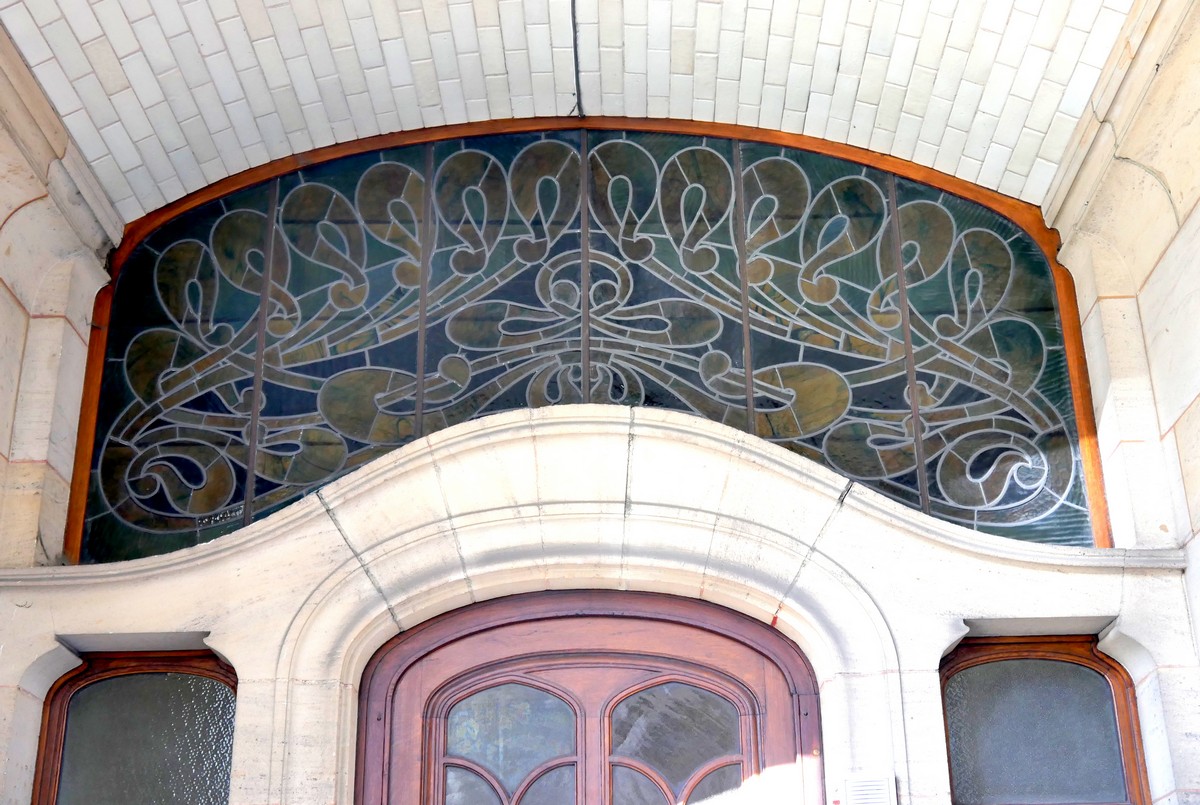
While some houses are not open to the public, some are adapted for museums, mostly dedicated to the building or its architect. Even some of those houses that are owned privately are accessible as part of special tours – every year during the weekends in March as part of BANAD – Brussels Art Nouveau & Art Deco Festival. It is a unique project across Europe that also offers the opportunity to meet the owners and talk about their interest in architecture as well as what it means to own a cultural heritage. Similar festivals are held every other year in the fall – the Biennial of Neoclassicism and the Biennial of Eclectic Architecture. More information: BANAD

Visitors to Brussels can buy a special Brussels Card – unlimited use of public transport and free admission to about 50 museums (eg Old England – Museum of Musical Instruments). However, there is also a special card for Art Nouveau architecture – Art Nouveau Pass – I had one with access to the Solvay House and two other of the six objects on offer. You can find the complete offer and prices here: Art Nouveau Pass
If you want to visit the House Solvay (which in my opinion is the best object), before buying the card, I recommend you to check whether there are still spots available for the tour because the interest is great and the tours can be booked out for several weeks in advance. You can check here: Solvay
During my stay in Brussels (February 2022), I had the opportunity to visit these eight objects (again, I use the French names hôtel and maison, where hôtel does not mean a hotel):
(1) Maison Couchie – Rue des Francs 5
1905, Paul Couchie

This house, which is located near the park with the Arc de Triomphe, is also called the house with the most beautiful façade. Although this house is only six meters wide, it cannot be overlooked – thanks to the façade. There are female figures reminiscent of those from Alphonse Mucha’s posters.


According to the attributes in their hands, we can easily recognize which figure symbolizes the art of painting, sculpture, jewellery making or architecture. As is usual in Brussels, the houses are named after their former owners, this one is called Cauchie. Paul Cauchie was an architect and decorator, and he built the house in 1905 for himself and his wife Lina, also an artist who was one of the first female students at the Academy of Fine Arts in Brussels.
The façade served also as an advertisement. It is created using the sgraffito technique (the work is created by scratching into a multi-layer smooth plaster so as to reveal parts of the underlying layer). Cauchie was a real specialist in sgraffito and, thanks to him, this technique was very often used during the Art Nouveau period.

Sgraffito also adorns the interior of the house. Cauchie was strongly inspired by Japanese art – a combination of opposing elements, stylized roses – in the interior and also on the façade.

The house has two entrances – also Japanese influence – but one of them is fake to confuse the devil.
The building is open every Saturday and the first Sunday of the month.
More information about the tours: Cauchie
(2) Old England – Rue Montagne de la Cour 2
1899 – 1899, Paul Saintenoy
This extravagant building made of glass and wrought iron is unmistakable in the row of houses near Mont des Arts due to its façade.


Originally, it was a department store that lured bystanders to shop through its large windows. Today, the Museum of Musical Instruments is located here. The museum is extremely interesting, but in addition to musical instruments, you should also notice the elevator shaft, railings and wall decorations with plant motifs, as well as cast the iron columns and bars with rivets. One floor is dedicated to this Art Nouveau building and its construction.


There is a restaurant on the top floor, from where you can also see the tower of Brussels City Hall.
More information: Museum of Musical Instruments
3) Former Bank Brunner – Rue de lai Loi 78, Wetstraat
Originally a private house, it was built in 1860 in neoclassical style on a spacious avenue. The area was beautified by parks and wide boulevards. Through the large door, it was possible to enter the house by carriage. Precious carpets were hanging on the walls instead of paintings. In 1899, the architect Léon Govaerts was commissioned to redesign the building into a bank in Art Nouveau style. There were rich families and investors living in the neighborhood, so there was no shortage of rich clients for the bank.
The bank’s rooms were decorated with mahogany furniture and bronze ornaments on the counters. A small stand for storing walking sticks has also been preserved. The glass dome flooded the interior with daylight.


After World War II, Brunner went to New York, where he opened a bank, as he did in Switzerland. The surroundings near his former bank in Brussels started to change, old houses were demolished and new European institutions were built. The wealthy clientele moved to the greener parts of the city.
More information about the tour options: Brunner
(4) Maison Autrique – Haachtsesteenweg 266
1893, Victor Horta
The star career of the most important Belgian Art Nouveau architect began in 1893 when he was commissioned to design a house for his friend from the Masonic Lodge of Brussels, the prominent lawyer Eugene Autrique, who introduced Horta to sophisticated circles where he found many of his future clients.
Autrique asked Horta to design a house without any luxury or extravagance. The floor plan and spatial composition remained quite traditional. On a narrow building plot that continues into the depths, the rooms were arranged according to the scheme used in most Belgian townhouses. In the three-room apartment, only the first and last room had windows, so it was pretty dark in the middle room which served as a dining room.

However, the new vision was reflected in the façade with an asymmetrical composition. The young architect was so enthusiastic about working on this building that he used white limestone on the façade – a stone which, according to him, was used by the greatest masters in the most beautiful buildings that everyone admired. However, he exceeded the planned costs with that material. Horta even gave up his fee in favour of the house.
The beauty of the façade is completed by large windows, slender cast-iron columns and a false loggia on the second floor with a wooden column. On the ventilation grilles and cellar windows, Horta used decorative elements reminiscent of the Masonic emblem with a triangle and a compass.
The House of Autrique was not yet completed when Horta designed the Hôtel Tassel, which is considered to be the first real building in the new style of Art Nouveau (more about this building: HERE).

The Autrique House is currently open to the public as a museum. The visitors get acquainted with Horta’s first architectural designs and immerse themselves in the atmosphere of a magnificent 19th-century residence. More information about the tours: Autrique
(5) Waucquez – Museum of Comics – Rue des Sables 20
1903 – 1906, Victor Horta
Horta soon became one of the most sought-after architects in the city. At the peak of his career, he built the Waucquez department store where fabrics were sold. After the owner’s death, the building began to decay. In the 1970s, it was threatened with demolition due to its dilapidated condition but fortunately, a complete reconstruction took place, supported mainly by Hergé – the author of the famous comic strip character of the curious reporter Tintin, but also by another great comic strip enthusiast – King Baudouin of Belgium. Thus, the building was saved and today, it houses a unique museum – the Belgian Center for Comic Strips (Center Belge de la Bande Dessinée).


On the façade, Horta combined seven windows in a light concave rhythm.
In the light-filled interior, you can admire the glass ceiling, a beautiful staircase, lamps, arabesques and iron columns. You can also sit inside the Art Nouveau restaurant.


More information: Center Belge de la Bande Dessinée
(6) Hôtel Max Hallet – Avenue Louise 346
1903 – 1905, Victor Horta
In my opinion, the façade of this house is quite inconspicuous, but from the back in the garden, it has a pretty futuristic look. Mainly thanks to the three large convex windows of the winter garden.


One of the main conditions of Max Hallet, a Belgian politician, was that his private sphere should be protected. This is still the case today – when there are guided tours of the house, the private rooms remain hidden. The current owner is the real estate developer Michel Gilbert, a big fan of Victor Horta. In 2006, he bought the house after being on the market for over two years. As he said: “These houses scare buyers. They are monsters. Max Hallet House has an area of 1,200 m². People rarely want to live in such a huge house. In addition, Horta’s houses are built to suit their owners, so it can be difficult to find a buyer who exactly meets the requirements of the original owner. And last but not least, these houses often need extensive renovation, which can mean a lot of bureaucracy and financial costs.”

The central element in the house is a beautiful staircase. Roses are painted on paper wallpaper on the walls, with only buds at the bottom and flowers opening towards the top.
More information about the tours: HERE
Photography not allowed.
(7) Hôtel Solvay – UNESCO! – Avenue Louise 224
1894 – 1898, Victor Horta
Ernest Solvay was a Belgian chemist, industrialist and philanthropist whose success had taken on a global dimension, so his financial situation allowed him to hire the then most expensive architect in Brussels to design a lavish residence for his son Armand, who had just married. A fifteen-meter-wide plot offered new opportunities to Horta to use his sense of light and space. The Solvay House is one of the best Art Noveau buildings in Europe and, what is rare, it has remained almost intact.

The façade was just being renovated, but I didn’t mind because I wanted to see the interior. And it was truly WOW! I will not describe it to you in detail, you really have to come and see it with your own eyes: the double fan-shaped dome, green marble stairs covered with a woollen carpet, the large painting “Reading in the Garden” by Belgian pointillist painter Thé van Rysselbergh above the stairs (ladies under the wild chestnut trees are debating books in the park near the Solvay Castle, you feel as if they are inviting you for a walk around the house), the mahogany and gilded iron stair railing, the warm colors of the interior with a motif of Horta’s wavy lines. The effect of colors, materials and painted decorations is intensified by the ingenious use of electric light. The Solvay residence was the first house in Belgium to introduce electric lighting. The bathrooms in the house are not large but equipped with all necessary comforts, such as heated linen cupboards.


During the construction of this house, Horta had an unlimited budget, so he could afford to use up to 17 types of marble and 13 types of wood (including rare tropical woods). He designed every detail, even the piano for the music salon, the pattern on the carpet or the bronze doorbell and the house number, so that everything corresponded to the style.

More information: Solvay
Photography not allowed.
(8) Horta Museum – UNESCO! – Amerikaansestraat 25
What kind of architect would he be if he didn’t design a house for himself and his family? In 1898, Horta bought two plots of land in the Saint-Gilles district to build a house and a studio. Construction work was completed in 1901. Horta designed a double building that clearly emphasizes two different functions. The studio is recognizable by the large window of the drawing workshop. The architect then employed sixteen draftsmen. The window is oriented to the north, so the artists always had the same cold light for their work.

The tall windows on the ground floor illuminated the office and also the sculpture workshop in the basement, where three sculptors made plaster and wooden models before construction.


The façade of the studio is simpler. On the façade of the private house, you can see a symbolism reminiscent of a water landscape. The fittings in front of the window on the ground floor symbolize the reed, on the balcony on the first floor, it has the form of stylized water irises and the whole is crowned by a dragonfly whose wings form a railing on the third floor. The metal is painted ocher-orange – an unusual colour for that time. Horta built three staircases in the interior: one for the family, one for the servant staff and one for the employees of his architectural office.
A self-guided visit to the museum is possible, a plan with a description of the individual rooms is available in various languages. You have the opportunity to see the music salon (Horta was a great lover of music), the dining room, Horta’s study, the telephone booth, the winter garden and also private rooms, bathrooms and other rooms. Photography is not allowed.


Just like in Horta’s other houses, I was fascinated by the flood of light – above the majestic staircase made of white Carrara marble, the architect placed an American glass skylight which intensifies the solar effect of the yellow walls. The higher a person climbs, the narrower the arms of the stairs. This is natural because there were fewer people on the upper floors than at the bottom of the house. But it’s also a useful way to bring more light into the interior. This is also helped by the unnoticed change in colors. While the orange ochre predominates at the bottom, the yellow of the glazed skylight and walls increases the brightness at the top.

By the way, in 1915, Horta went to London for a congress. It was already during the First World War, Belgium was occupied and it was not possible for him to return home. He, therefore, travelled to the USA, where he gave a series of lectures at renowned American universities. He returned to Brussels in 1919 – Art Nouveau was already out of fashion. Horta sold his house and moved to a neoclassical mansion at Avenue Louise. Since then, he began to simplify his style and use more geometric shapes. To honour his work, King Albert I awarded him the title of Baron in 1932. Eight years later, Horta began writing his memoirs. Unfortunately, he did not want his professional work to be preserved for future generations – he burned most of his drawings and designs …
His house, along with the other houses of Tassel, van Eetvelde and Solvay, was inscribed on the UNESCO World Heritage List in 2000.

More information: Horta Museum
My thanks to explore.brussels for providing the pictures of the interior of the houses Max Hallet and Solvay and to Horta Museum for the picture of the interior of the museum.
More information: https://visit.brussels/en and https://www.explore.brussels/en/
Text: © Copyright Ingrid, Travelpotpourri
Fotos: © Copyright Ingrid, Travelpotpourri





Comments 1